
OCU-UGCC Dialogue & an Eastern Catholic Profession of Faith


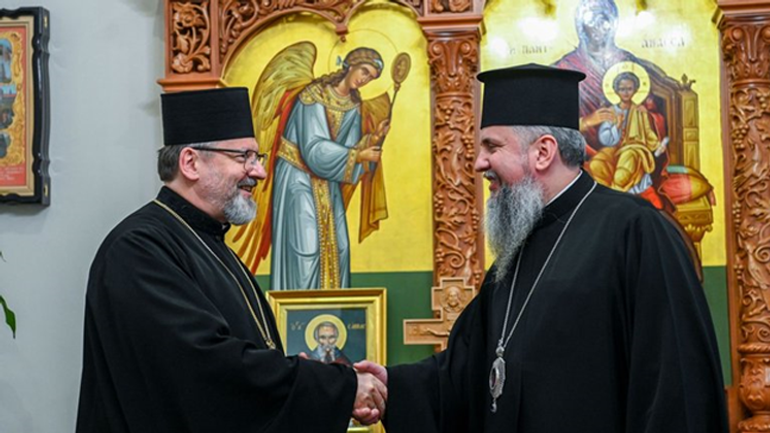
In 2019, Metropolitan Epifaniy of the Orthodox Church of Ukraine (OCU) said that "the key [to Catholic-Orthodox unity] lies in Rome and Constantinople." Yet, just after this past Christmas, Patriarch Shevchuk of the Ukrainian Greek Catholic Church (UGCC) called for a direct dialogue between the OCU and UGCC: Many of the agreements already achieved by the Joint International Commission for Theological Dialogue between the Catholic Church and the Orthodox Church, said the Patriarch, "are not even known in Ukraine." Therefore, a local dialogue represents an opportunity to receive the fruits of the international dialogues and thereby to develop the unified voice of Ukraine's Eastern Christianity.
As a preliminary contribution to this local dialogue, I would like to explore the following question: Are there any dogmatic differences that divide the OCU and the UGCC? Of course, the churches are divided because they belong to different communions - of Rome and of Constantinople - though this schism of communions may soon be overcome. In the event of their unification, the UGCC and OCU would also have to address some differences in administrative documents and structures and procedures. But now, at this moment, do they differ at all in faith?
The question is perhaps surprising. Many may think that the answer is obvious. Doesn't the Catholic faith differ from the Orthodox faith because of the development of doctrines like the Filioque and Purgatory? But this isn't obvious. From the Union of Brest in 1596, when the UGCC restored communion with the Church of Rome, the UGCC did not receive these Roman doctrines. And yet the UGCC remains part of the Catholic communion today.
One might still ask: Doesn't the Catholic faith differ from the Orthodox faith because of Catholic doctrines concerning Mary or the Pope? Again, this isn't obvious. Each issue requires examination. Regarding papal primacy, the UGCC may hold as little as the following:
- Forms of primacy, conciliarity, and synodality appear at every level of the Church - local, regional, universal;
- universal primacy among the churches belongs to the See of Rome; and,
- by virtue of his office, her pontiff may when necessary (e.g. in cases of emergency) intervene anywhere in the Universal Church.
The question of how the Pope should exercise this primacy and whether it has been exercised well or poorly in the past are different matters - of praxis and history rather than doctrine. It is not clear that these statements on the topic of primacy inadequately express the faith of the UGCC, on the one hand, or depart from the faith of the OCU, on the other.
The ambiguity does not resolve in any way the question of whether the UGCC and OCU differ in faith. It only indicates that the answer cannot be taken for granted. This same ambiguity lies at the very heart of Eastern Catholic identity: Apart from communion with the Roman See, how do Eastern Catholics differ from their corresponding co-religionists? What blessing or burden does their communion with the Church of Rome entail?
One answer was proposed in 1995 by Melkite Catholic Bishop Elias Zoghby. He made this Profession of Faith:
- I believe everything taught by the Eastern Orthodox Church; and
- I am in communion with the Bishop of Rome, as the first among the bishops, according to the limits recognized by the Holy Fathers of the East during the first millennium, before the separation.
In short, Bishop Zoghby denied any doctrinal difference with the Orthodox and any burden born of communion with Rome. He went on to deny the ecumenical status of the councils of the second millennium that Catholics have counted as ecumenical since the time of Robert Bellarmine, and he sought the immediate restoration of communion between, if not the full reunification of, the Melkite Catholic Church and the Antiochian Orthodox Church.
Although supported by Melkite Catholics, neither Rome nor the Antiochian Orthodox accepted his proposal. Before any restoration of communion, both parties sought further agreement regarding developments in the second millennium.
The "official" Catholic Profession of Faith last amended by Ad Tuendam Fidem in 1998 begins with the Nicene-Constantinipolitan Creed (with the Filioque, though its inclusion is likely not expected of Eastern Catholics) and then covers all further doctrinal developments with three broad statements:
- With firm faith, I also believe everything contained in the word of God, whether written or handed down in Tradition, which the Church, either by a solemn judgment or by the ordinary and universal Magisterium, sets forth to be believed as divinely revealed.
- I also firmly accept and hold each and everything definitively proposed by the Church regarding teaching on faith and morals.
- Moreover, I adhere with religious submission of will and intellect to the teachings which either the Roman Pontiff or the College of Bishops enunciate when they exercise their authentic Magisterium, even if they do not intend to proclaim these teachings by a definitive act.
These three statements are all-encompassing, covering every development of doctrine. They correspond to three "ranks" of doctrine - (i) doctrines divinely revealed, the rejection of which is heresy, (ii) doctrines taught definitively, the rejection of which impairs communion, and (iii) everything else that the Church proposes for belief, the rejection of which constitutes disobedience.
Let's compare these two Professions of Faith: Bishop Zoghby's doesn't address doctrinal developments of the second millennium, while the official one does so but leaves their content wholly implicit. Bishop Zoghby's indicates a great degree of agreement between Eastern Orthodox and Eastern Catholics but leaves the content of this agreement implicit, whereas the official Profession of Faith doesn't indicate agreement with anyone, though it is explicit about the content of the faith at least by including the Nicene-Constantinopolitan Creed. Neither of them is adequate to answer the question that lies at the heart of Eastern Catholic identity.
To shed some further light on the question, then, I will attempt in the following to render explicit more of the essential points of the faith of Eastern Catholics - as best I can, coming from a Roman Catholic perspective - and comment along the way regarding its agreement with the Eastern Orthodox faith.
A Common Foundation: The Nicene-Constantinopolitan Creed
Certainly, any explicit Profession of Faith should begin with the Nicene-Constantinopolitan Creed - stated here without the Filioque, whose status will be addressed later:
- I believe in one God, the Father almighty, maker of heaven and earth, of all things visible and invisible.
- I believe in one Lord Jesus Christ, the Only Begotten Son of God, born of the Father before all ages. God from God, Light from Light, true God from true God, begotten, not made, consubstantial with the Father; through him all things were made. For us men and for our salvation he came down from heaven, and by the Holy Spirit was incarnate of the Virgin Mary, and became man. For our sake he was crucified under Pontius Pilate, he suffered death and was buried, and rose again on the third day in accordance with the Scriptures. He ascended into heaven and is seated at the right hand of the Father. He will come again in glory to judge the living and the dead and his kingdom will have no end.
- I believe in the Holy Spirit, the Lord, the giver of life, who proceeds from the Father, who with the Father and the Son is adored and glorified, who has spoken through the prophets. I believe in one, holy, catholic and apostolic Church. I confess one baptism for the forgiveness of sins and I look forward to the resurrection of the dead and the life of the world to come. Amen.
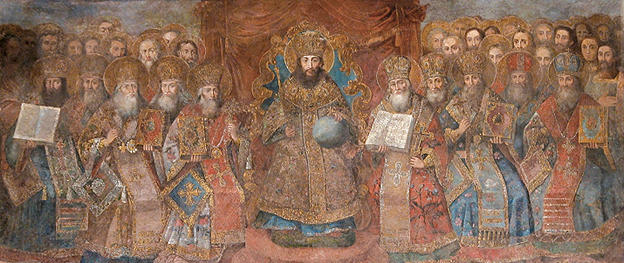
The Seven Councils
To avoid any abstraction of doctrinal propositions from the living community of the Church, to follow a certain tradition in the expression of the faith, and to respect the identification of the Eastern Orthodox Church with the Ecumenical Councils, we could add the following point:
- I believe according to the faith of the apostles and as expressed by the fathers assembled at Nicaea and Constantinople.
To cover the doctrinal developments of all seven of the ancient Ecumenical Councils, we could add the following as well:
- With the fathers assembled at Ephesus, at Chalcedon, and twice more at Constantinople, I confess the same faith in one Lord Jesus Christ, the Only Begotten Son of God, perfect in divinity and perfect in humanity, truly God and truly man in body and soul, consubstantial with the Father in divinity and consubstantial with us in humanity, like unto us in all things but sin, not made but begotten of the Father before the ages in His divinity and in these last days for us men and for our salvation, coming down from heaven and by the power of the Holy Spirit, incarnate and born in his humanity of the Virgin Mary, the Mother of God. His divinity and his humanity are one, without confusion, without change, without division, without separation, their distinction, virtual and conceptual, never abolished but their characters preserved, each willing and performing what is proper to it in communion with the other, together in one Person and Subject, God the Word, through whom all things were made.
- With the fathers assembled again at Nicaea, I profess it right to depict Jesus Christ our God in His humanity, as well as evangelical scenes; I profess it right to venerate Mary and the saints, as well as the relics and images of Jesus and Mary and the saints.
So far, I expect that the UGCC and OCU would be in complete agreement.
Additional Ecumenical Councils?
A new issue arises with respect to the enumeration of Ecumenical Councils. Catholics often count 21, while the Orthodox often count 7. Until the 11th century, Catholics and Orthodox together counted 7. For Catholics to count 21, they have to employ a definition of Ecumenical Councils proposed by Robert Bellarmine in 1586, while the Orthodox typically follow an account of Ecumenical Councils proposed by Nicodemus of the Holy Mountain in 1800. Several aspects of this controversy are unclear: It's not clear that Catholics must count 21 or use Robert Bellarmine's definition or that Orthodox must count 7 or use the account of Nicodemus; it's also unclear whether this issue is church-dividing. Yet, it's clarification must enrich our shared ecclesiology and help to organize our explication of the faith.
In the Chieti Document of 2016, the Catholic and Orthodox Churches together acknowledged an earlier set of criteria for enumerating Ecumenical Councils: According to Nicaea II, an Ecumenical Council requires "[i] the agreement (symphonia) of the heads of the churches, [ii] the cooperation (synergeia) of the bishop of Rome, and [iii] the agreement of the other patriarchs (symphronountes)." Unfortunately, how "symphonia," "synergeia," and "symphronoutes" may have been intended as distinct from each other is not clear.
Since medieval times, the Orthodox Church has objected to receiving councils as Ecumenical Councils that were convened in the West without their knowledge or participation. The objection is reasonable, and the Church of Rome has expressed openness to revisiting her count of Ecumenical Councils. However, she likely hesitates to acknowledge the participation of the Eastern Churches as a necessary condition for a council to be ecumenical, since she herself did not participate in all of the first seven Ecumenical Councils. If Rome can receive an Ecumenical Council after the fact, can't the Eastern Churches do likewise?
If not, Ecumenical Councils may remain forever a largely Eastern phenomenon. But if so, perhaps Catholics and Orthodox already agree on the following account:
- A council is orthodox if it teaches in accord with Sacred Scripture and previous Ecumenical Councils;
- if a council finds wide reception, especially among the Eastern Patriarchates, and the approval of Rome, it may be received with or assigned its own proper number in the sequence of Ecumenical Councils, without which it cannot be an Ecumenical Council; and
- ecumenical reception “has always been the ultimate criterion for the ecumenicity of a council” (Cf. Chieti Document §18).
This account leaves open the possibility that some councils of the second millennium could still find reception in the East and consequently enumeration as Ecumenical Councils. On the basis of this agreement, I think the UGCC could count just 7 Ecumenical Councils. And anyone - Catholic or Orthodox - could either anticipate the ecumenical reception and enumeration of additional councils as Ecumenical Council from the second millennium or not. This can remain an open question of ecclesiology.
Another Issue of Councils: Constantinople IV
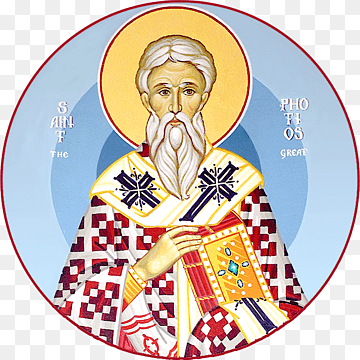
Even if the UGCC were to count only 7 Ecumenical Councils, there is still controversy over the councils that have been called "Constantinople IV." The controversy behind the councils began with a schism between the followers of two sequential patriarchs of Constantinople. A council was summoned to resolve the schism in 859, interrupted by violence, and then reconvened in the presence of delegates from Pope Nicholas I in 861; this council, called the "First-and-Second Council," deposed Patriarch Ignatius and confirmed Patriarch Photios. However, conflict over territory continued between Nicholas and Photios, so that each convened a local synod against the other in 863 and 867, respectively. Catholics call "Constantinople IV" a subsequent council attended by Roman delegates in 869-870 that deposed Photios and reinstated Ignatius. Finally, after the death of Ignatius, a third council attended by Roman delegates in 879-880 suppressed the council of 869-870 and confirmed Photios as patriarch. This was the "Council Held in the Temple of Holy Wisdom," which the Orthodox sometimes call "Constantinople IV."
After the schism between Rome and Constantinople in 1054, the Church of Rome began to count the council of 869-870 as the Eighth Ecumenical Council. Although the council of 869-870 was suppressed in order to reinstate Photios, neither Pope John VIII who received the Council of 879-880 nor Pope Gregory VII in the 11th century considered the canons of 869-870, apart from those directed at Photios personally, stricken from the shared canonical tradition of the Church.
At times, the Orthodox have called the council of 879-880 the Eighth Ecumenical Council. Some have argued that it condemned the Filioque clause. However, if this was the intention of the council fathers, they failed to do so explicitly. In any case, the council restored communion between Constantinople and Rome and through Rome with the Franks who employed the Filioque at the time. More often, the Orthodox have denied the status of this council as an Ecumenical Council because it did not produce any explicit dogmatic definition. However, in the first millennium, this wasn't considered a necessary condition for a council to be an Ecumenical Council.
Given the complexity of the circumstances around these councils of the 9th century, they have long been a source of polemic and confusion. At a minimum, the polemics from this period should be set aside. It should be acknowledged that Pope Nicholas of Rome and Patriarch Photios of Constantinople contended bitterly, yet it is right for Catholics and Orthodox to venerate both of these holy men, and together they ought to venerate them both. It is also clear that a case can be made for counting the council of 879-880 the Eighth Ecumenical Council. It might be even more beneficial and enriching to both East and West to count all these councils together. Consequently, to resolve contention over Ecumenical Councils, I would like to confess the following:
- I count one last Ecumenical Council that gained the consent of the Patriarchs of East and West, the Fourth of Constantinople, assembled in 859 and 861 (First-and-Second Council), 869-870 (the condemnation and canons 2, 4, 6, 9, and 25 of this time being suppressed, directed as they were against St. Photios of Constantinople personally), and 879-880 (Council in the Temple of Holy Wisdom).
(17 canons from the First-and-Second Council + (27 canons - 5 suppressed canons = 22 canons from 869-870) + 3 canons from 879-880 = 42 canons of Constantinople IV)
Two Catholic Doctrines of the Middle Ages: the Filioque and Purgatory
In the second millennium, relations between the Church of Rome and Constantinople suffered when Rome began to make liturgical use of the Nicene-Constantinopolitan Creed with the Filioque clause in 1014 and then with the subsequent mutual excommunications of 1054. From the 11th century on, the two sees also contended over papal primacy, liturgy, the status of the Council of 869-870, soteriology, and Purgatory. Yet, not all of these disputes were considered church-dividing.
At the time of the Union of Brest in 1596, the UGCC accepted a sense of papal primacy and the validity of sacraments in the Latin Church but did not receive as her own the Roman doctrines of the Filioque or Purgatory. However, it must be acknowledged that by restoring and maintaining communion with Rome the UGCC holds at least a negative and implicit doctrinal position regarding the Filioque. To make this position explicit in relation to Orthodox objections to the Filioque, we could state it as follows:
- I deny that the Church has ever erred in teaching that the Holy Spirit proceeds from both the Father and the Son or thereby contradicted the monarchy of the Father or thereby confused the properties of the Persons of the Blessed Trinity.
In other words, the UGCC does not profess the Filioque clause, yet neither does she accuse the Church of Rome of heresy for doing so.
The UGCC likely holds a similar negative and implicit position regarding Purgatory and the Roman practice of granting indulgences. To make this position explicit and to answer the soteriological and ethical objections to the doctrine and practice, we could state the position as follows:
- I deny that the Church has ever erred in teaching that a debt of temporal punishment may remain to be discharged after death or that she has power to remit it - insofar as the debt to be remitted serves not to free the dead from attachment to sin but to deter the living from the same and insofar as its remission serves to edify the living and to comfort the dead.
Again, the UGCC does not teach the doctrine of Purgatory or grant indulgences, yet she does not accuse Rome of heresy for doing so.
These two doctrinal positions of the UGCC are not obviously shared by the OCU. However, further dialogue, especially at the international level, could uncover these positions as implicit in the faith of the Orthodox Church. The Joint International Commission for Theological Dialogue between the Catholic Church and the Orthodox Church has recently begun work on a new document on the Filioque.
More Catholic Doctrines: Tridentine and Marian
Apart from these negatively stated doctrinal positions, there are likely several additional doctrinal positions that the Church of Rome expects Eastern Catholics to profess. At least this is suggested by the doctrinal note by Cardinal Ratzinger that accompanied Ad Tuendam Fidem in 1998. These include doctrines defined by the Council of Trent, the First Vatican Council, and the papal declarations ex cathedra of 1854 and 1950.
Some of these may cause no concern for the Orthodox as far as doctrinal content; these doctrines may reflect the same faith. Yet, simply the act of articulating them by Eastern Catholics may cause concern among the Orthodox, because it is the Church of Rome insisting on them. In response to this concern, the UGCC could argue that she can profess certain doctrines at the behest of Rome
- without thereby counting as Ecumenical Councils the councils which the Church of Rome has so designated in accord with the definition of Robert Bellarmine and
- without thereby assuming or pre-judging the account of papal teaching authority provided by Vatican I.
Rather, if the UGCC is willing to articulate additional doctrines favored by Rome, she can also hold both
- that she does so in obedience to the dictum of St. Irenaeus of Lyons that every church should agree with the Roman Church and
- that these doctrines ought to be taught by a future Ecumenical Council that finds truly ecumenical reception.
For example, responding to the Council of Trent and without thereby distorting or replacing her own concept of original or ancestral sin, the UGCC might confess the following:
- To remain always in agreement with the Church of Rome, I hold baptism to forgive sins both actual and original and that original sin, which is in all men without personal fault, wounds all men in body and soul, and deprives all men of holiness and justice, can be and truly is taken away not by the powers of man nor by any other remedy but only by the merits of the one mediator our Lord Jesus Christ.
- I confess that the sacraments received and recognized by the Church were instituted by him and confer upon those who place no obstacle in the way, by the performance of the rites themselves, the comprehensive graces necessary for their salvation; that in the divine liturgy a holy sacrifice is offered to the Father; and that in Eucharist Jesus Christ is truly, really, and substantially present by the power of the Holy Spirit.
Although East and West have described ancestral sin and original sin differently and have at times argued over these differences, it is unclear that any doctrinal disagreement remains unsettled between the Catholic and Orthodox Churches in relation to these key points from Trent.
There has been more argument between East and West regarding the Catholic doctrine of the Immaculate Conception, but the UGCC can likely receive this doctrine too without distorting her traditional concept of ancestral sin or replacing her concept with a Roman concept. She might adequately express the Catholic Marian doctrines as follows:
- I profess that the Virgin Mary, the Mother of God, was preserved by Christ from sin and now reigns with him, body and soul, in heaven.
These positions are shared by the OCU - if not as doctrines, then at least as acceptable theological opinions.
One More Hurdle: Vatican I
Finally, we arrive at the most developed Catholic doctrines of the papacy. When the Holy Synod of the Antiochian Orthodox Church rejected the initiative of Melkite Catholic Bishop Zoghby, they held that Eastern Catholics should return to the more ancient enumeration of Ecumenical Councils and singled as especially problematic among the Western councils Vatican I.
The Church of Rome has long been aware of the difficulties presented by the papal doctrines of the First Vatican Council and has recently proposed a "re-reception" of Vatican I and perhaps a new formulation of these doctrines. The Joint International Commission for Theological Dialogue between the Catholic Church and the Orthodox Church has already produced three documents that address papal primacy - Ravenna (2007), Chieti (2016), and Alexandria (2023) - and now it has begun a new document on the topic of papal infallibility.
These documents have nearly resolved doctrinal disagreement over papal primacy. Catholics and Orthodox together acknowledge that universal primacy among the churches belongs to the See of Rome. From this premise, at least the Church of Constantinople, if not other Local Churches as well, conclude that when necessary the Roman Pontiff may intervene anywhere in the Universal Church. But not all of the Orthodox Churches agree.
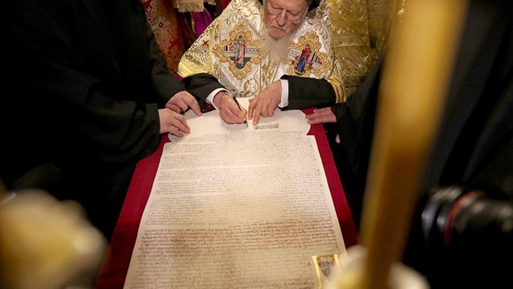
This is an issue that touches the OCU deeply: Why was Ecumenical Patriarch Bartholomew authorized to intervene in the canonical territory of the Russian Orthodox Church (ROC) to restore the Ukrainian Orthodox Church - Kyiv Patriarchate (UOC-KP) and Ukrainian Autocephalous Orthodox Church (UAOC) to communion in 2018 and to grant autocephaly to the OCU in 2019?
- Was it because the territory of Ukraine never in fact belonged to the canonical territory of the ROC, per the Patriarchal Letter to the Kings of Russia of 1686?
- Was it because the Ecumenical Patriarchate of Constantinople perpetually retains a "pentarchal" right of jurisdiction to intervene when necessary in the affairs of her daughter churches in Eastern Europe?
- Was it because the right to intervene when necessary anywhere in the Universal Church belongs to her first primate and this right in the Orthodox Church has temporarily devolved upon the Throne of Constantinople while the schism lasts with Rome?
Many Orthodox will assent to all three. It is not necessary for the OCU or the UGCC to assent to all three - this is an ecclesiological question for them to tackle. Yet, if anyone assents to a right of the first primate to intervene when necessary anywhere in the Universal Church, in light of the achievements of the international Catholic-Orthodox dialogue, no doctrinal disagreement on the topic of papal primacy remains between him and Rome; there is only need to work out how papal primacy should look in practice in a reunited Church.
There is less material available on the topic of papal infallibility. Yet, it can be approached in a way analogous to papal primacy. Just as the Catholic-Orthodox dialogue has agreed that "universal primacy among the churches belongs to the See of Rome" and derived thence a right of intervention for her pontiff, so too could Catholics begin to discuss papal infallibility with the ancient dictum that "unfailing faith belongs to the See of Rome."
This premise can't go very far if the Orthodox hold Rome to have fallen into heresy and therefore reject the position out of hand. But if it is found that it was once ecumenically believed that Rome would never fall from the apostolic faith and if it is found that Rome has never in fact fallen from the apostolic faith, then some sense of Roman indefectibility belongs to the apostolic faith. If so, this sense may have informed the distinction by Nicaea II between the "synergeia" of the Roman Pontiff and the "symphronountes" of the other Patriarchs in relation to Ecumenical Councils.
In order to derive a conclusion regarding the teaching authority of the Roman Pontiff, Roman indefectibility must be set in a broader ecclesiological context - in relation to the infallibility and teaching authority of the Universal Church. Although it’s unclear for now how Rome intends to reformulate the doctrine, perhaps we can anticipate a careful, ecclesiological expression, such as follows:
- I profess that all that the Church believes concerning faith or morals definitively and ecumenically, she believes infallibly, and all that her bishops, the successors of the apostles, teach concerning faith or morals definitively and ecumenically they teach infallibly and must be believed definitively; I confess that universal primacy and unfailing faith belong to the Roman See, so that what her pontiff teaches concerning faith or morals most solemnly (ex cathedra) is likewise taught infallibly and must be believed definitively (if ever he dares such a definition and without prejudice to how the local churches might apply it with pastoral prudence).
The Orthodox will not readily assent to this position; however, further dialogue will show whether it already lies implicit in the faith of the Orthodox Church.
Conclusion: Still Seeking Unity in Christ
This brings to a close the additional points of doctrine that either the UGCC holds or Rome expects her to hold. I've formulated these to the best of my ability, though clearly some are more firm and others are more speculative. I am unaware of other attempts like the 13 points marked (❖) above at a specifically Eastern Catholic Profession of Faith.
So we return to the question: Do the UGCC and OCU differ at all in the faith? I think the answer is still: Maybe; but maybe not. Certainly, by virtue of her communion with Rome, the UGCC is committed to at least some negative and implicit doctrinal positions, yet both these positions and other positions that she might hold at the behest of Rome may also belong, still implicitly, to the faith of the Orthodox Church. It is the task both of the Joint International Commission for Theological Dialogue between the Catholic Church and the Orthodox Church and of the UGCC and OCU locally to discern whether this is the case.
The resolution of doctrinal issues is just one step toward the unity to which Jesus Christ enjoins His disciples. On the side of praxis, the Catholic and Orthodox Churches should still oversee
- the abrogation of the Code of Canons for the Eastern Churches (CCOE) for the sake of restoring more authentic traditions of Eastern canon law,
- many unifications of corresponding churches, like the OCU and UGCC,
- the reform of the diptychs,
- the harmonization of pastoral approaches to failed marriages and reform of the accompanying canonical procedures, and
- an ecumenical decision on the date of Easter.
Perhaps not every one of these steps is necessary, but all of them would serve to draw us closer in Christ.
Maybe many readers remain skeptical that Catholics and Orthodox share one and the same faith. Some skepticism is good and fruitful, but we must recall that only rarely does God force us to see what we prefer not to see, like He did with St. Paul on the road to Damascus. Rather, we must desire to discover our unity in faith. If we do so desire, then I think we will see it and see it in truth.