
Becoming a Silent Friend to Those Who Suffered a Loss — Pastor Viktor Haiduchok on Ministry to the Families of Soldiers


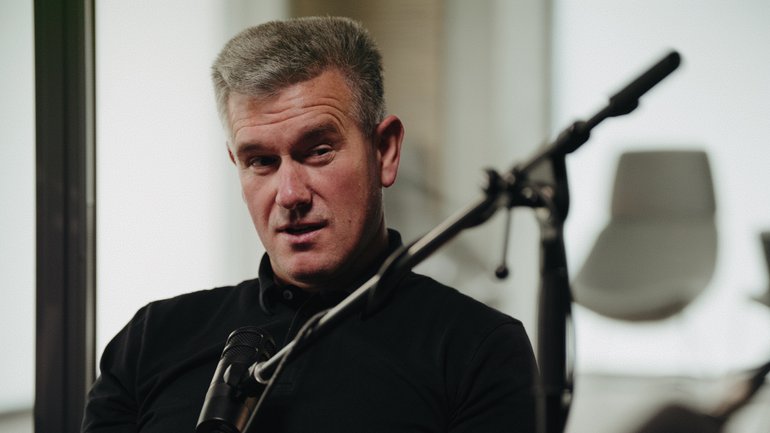
In this conversation, we discuss how people with very different experiences of war can coexist within the church, why both pacifism and militarism can become extremes, and the questions a person asks God when war and pain become personal.
This is the text version of the podcast “Without Armor” — a joint project of the Ukrainian Baptist Theological Seminary and the “Ukraine for Christ” mission — published as part of an information partnership with RISU.
“In the Baptist tradition in Ukraine, pacifism has long been — and in some places still remains — an almost unspoken norm. You are both a pastor and a reserve officer. How did your views on war and military service take shape?”
“I have always held militarist views. I studied at a military department and took an oath of allegiance to the people of Ukraine. But even before that, I had taken an oath of allegiance to the Lord.
My convictions became especially firm during the war, and most of all after the death of our son-in-law. That is when I began to dig more deeply into these questions for myself.
I will admit that after Bohdan’s death, I had a strong urge to go and fight. But I started praying and honestly asked myself why I wanted to do this. And I realized: what was driving me was not only a desire to defend, but also a desire for revenge.
That is when I understood: the desire for revenge is wrong. The desire to defend is right.”
“Was it easy to be both a militarist and a minister in a Baptist church? Or did these questions simply not come up before?”
“When there was no war, these questions did not come up. In reality, circumstances do not so much shape our convictions as reveal them.
The first such discussions began back in 2014. At that time, at our Union’s congress, the first positions were formulated stating that we hold two views — militarist and pacifist — and that this is a matter of a person’s free choice and conscience.
But Scripture calls us to this: a person should act according to conscience and not judge another’s position because this topic can easily spiral out of control. Some will say, ‘You’re scoundrels for taking up arms.’ Others will say, ‘And you’re cowards.’ And it can go very far from there.
For me, it is important that, holding a militarist position myself, I do not condemn a pacifist. But there is a nuance here: people should not use pacifism to hide their fear.”
“What was the start of the war like for you?”
“During the last week before the full-scale invasion, we pastors of Lviv gathered and discussed how we would act if war broke out. Some of the brothers, myself included, were convinced it would happen.
In the morning, a phone call woke me. I picked up, and they told me: ‘Ivanovych, the war has started.’ I woke my wife, and there were no thoughts, no fear, no emotions. Just shock. That is how I met the war.
Then I started gathering my documents. The children sensed something was wrong, stood in the doorway, and asked, ‘Dad, where are you going?’ I told them I had some business to attend to. Though, of course, I was heading to the enlistment office. But the children took my documents away and would not let me leave. They said, ‘There are going to be a lot of people here soon — displaced people. We need to organize ministry and help right here.’”
“Do you regret that decision?”
“I have always prayed to be at the epicenter of God’s events. Both then and now, my convictions have not changed. I want to be wherever the Lord wants to see me.
Do I regret it? No. The podcast is called ‘Without Armor,’ right? Well, I now have an exemption — I think since last summer. But before that, I traveled everywhere: I went to enlistment offices, to checkpoints. Several times, I was stopped and had my documents checked. I did not run away. And they told me, ‘You don’t suit our needs. Safe travels.’
I understand it this way: my life and my fate are in God’s hands. And running off to the front against God’s will, when the Lord wants to see you here, is wrong. Just as it is wrong to stay here while running away from the possibility of being at the front.”
“Have you and your church changed during the war?”
“Have I changed? Probably, yes. Stress, and everything that war brings, sooner or later affects a person, no matter how hard you fight it or how much you trust God. It affects both your health and your endurance. I find that now I need more time to recover than I used to.
The church has changed a great deal, too. Thank God, not that many people left at the start of the war. All the pastors and key people stayed in place.
The war pushed the church toward ministry. At first, it was a ministry to displaced people, and later to soldiers as well. Now our church bus travels east every month — to our soldiers and to the various brigades we are in contact with.
This is how ministry emerged for the families of fallen soldiers, and for wounded servicemen in hospitals and rehabilitation centers.
And God raised new people — people who had seemed almost invisible before, who had been less active, and who are now involved in this ministry.”
“Your son-in-law, Bohdan Rilnyk, was killed at the front. Tell us about him. What was he like? And how are you living through this loss?”
“You could say Bohdan had, in a sense, ‘two right hands.’ He always took on everything and was always active in the church. A brother-in-arms who was wounded alongside him later said, ‘I understand that I survived because Bohdan took the first hit.’ He always wanted to help, to do something for others. And he died, in effect, after repairing a broken machine gun — even though that was not even his task; in his free time, he was helping his fellow soldiers.
With God’s help, we are getting through this loss. At first, it was much harder; now it is a little easier. They say time heals. But from this ministry and my own experience, I understand that time alone does not heal. Healing wounds of the soul, like healing wounds of the body, takes both time and the right treatment. And the Lord is the Physician who heals and sustains.
I started going to the Field of Honor back in the autumn of 2022. I simply supported the families of the fallen. And once, on my way back from there — Bohdan was already serving at the time — I was struck by a horrifying thought: ‘Will I one day have to help my own daughter in the same way?’
So, after Bohdan’s death, this ministry entered a new phase. It became more than just my personal ministry — it became a ministry of our whole family, and of our church.”
“How did the loss of your son-in-law affect your relationship with God?”
“When Bohdan died, I happened to be reading through the Old Testament in my daily Bible reading. But at that point, I stopped. I did not stop reading Scripture altogether — I simply began reading the Psalms more. Because that is the book through which God speaks, especially to a person’s heart and emotions.
And from the moment of Bohdan’s death until the funeral itself, I kept the Gospel of John open — the story of the raising of Lazarus. I read it every day and prayed.
I put many questions to God. And once, during prayer — not as a literal voice, but inwardly — I sensed an answer. As if God asked me, ‘And why should others have to die, but not your son-in-law? This is war, after all.’
And I found no answer to why others have to lose their loved ones, and I do not. That is war.
I also thought a lot about John the Baptist. He was just past thirty — quite young. From a human point of view, his death looks senseless: he was beheaded in prison because of someone’s whim. And the question arises: why couldn’t he have lived longer?
But he fulfilled his mission — he presented Christ to the people. And God took him in exactly that way.
So I think that Bohdan, like so many others who have already passed into eternity, also fulfilled their mission. Their mission was to defend their people — us — at the cost of their own lives.”
“During wartime, how can a person understand where their place is and where the Lord is calling them?”
“I believe, and I am convinced, that there are no coincidences in our lives. Coincidences are not really coincidental. That is what the Bible teaches.
And more than once, I ask myself questions I have no answer to. Why does what happens to a person happen the way it does? Why, during a strike, does this particular person die and not another? Why does one person go through the whole war without a single wound, while another dies in their first battle, like our Bohdan?
I do not have an answer. But I find my own explanation in the fact that I am in God’s hands. Every human destiny comes from God.
You can run. Sometimes God even allows you to run. But that is your choice. And every choice has its price. We pay it whether we stay here or leave the country during the war. We simply do not know what the consequences will be — here or there.
So if you answer God’s calling, then it is the best path for you — even if it is not always easy or pleasant for us.
In chapter 11 of the Letter to the Hebrews, the heroes of faith are described. Some were persecuted, tortured, and killed. Others lived long, peaceful lives. But both groups are called heroes of faith. Why? Because they trusted in God’s will and carried it out.”
##DONATE_TEXT_BLOCK##