
Still on the “White Horse”: Russist Lobbyists in Ukraine


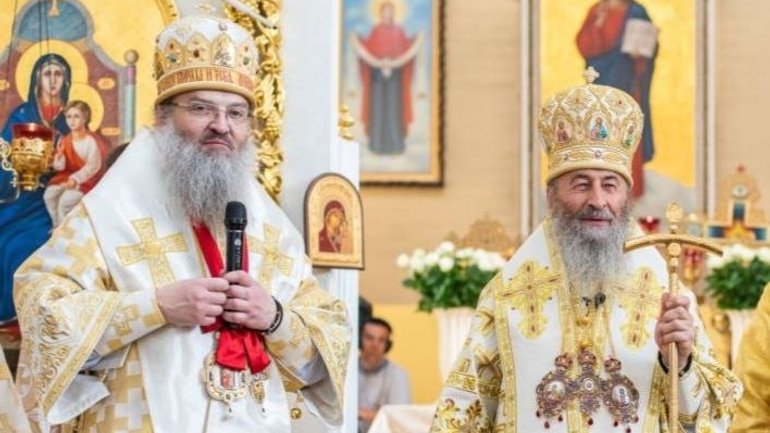
For nearly five years now, this country has been the target of a full-scale, deliberate campaign of banditry — killed, bombed, and shelled with missiles — and yet one of its metropolitans, giving an interview to a foreign outlet, did not utter a single critical word about the aggressor state, its president, or the patriarch who blesses the war. Is such a thing even possible? Yes, it is. In Ukraine. Today. “Nothing like this has ever happened before, and here it is again” — the phrase once used by Viktor Chernomyrdin now fits, once more, the activity of Metropolitan Luka of Zaporizhzhia and Melitopol (Andriy Kovalenko), who has yet again demonstrated his ongoing cooperation with Russism. This “ruler of minds” gave an interview on May 25, 2026, to the Serbian outlet Život Crkve (Ukrainian translation).
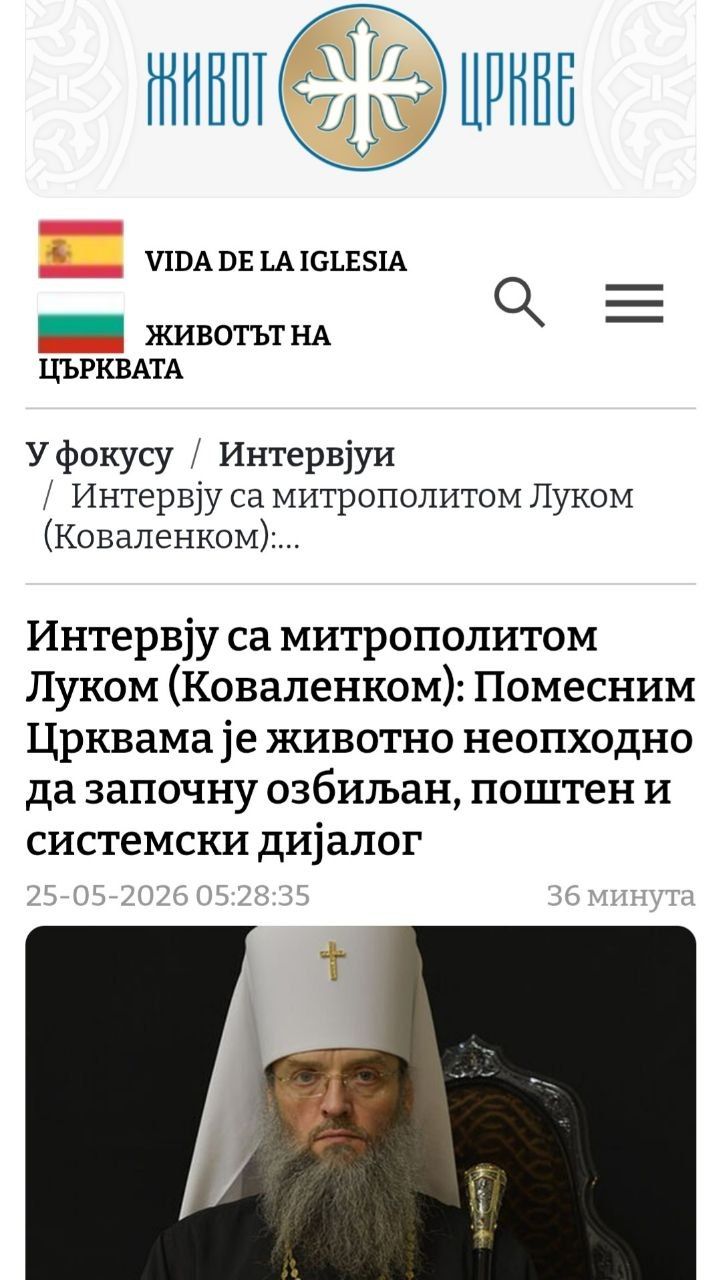
The rule of the Russian Orthodox Church (ROC) in the occupied Ukrainian territories — including in parts of Zaporizhzhia region (for example, the appointment in 2025 of a bishop for Berdiansk, a man who until then had served in a remote corner of Siberia) is nothing that Luka, despite having an international platform, thinks worth telling the world about, saying: “Here is evil. Do something, stop it.” Far from it. Yet in the same interview, he speaks at length about the so-called “seizure” of UOC churches by the Orthodox Church of Ukraine (OCU), hurling invective at it.
Naturally, Luka's answers in the interview are full of the same propaganda narratives we have already seen and heard dozens of times on official ROC platforms and in the rhetoric of Russia's state propagandists, its own Goebbelses. The metropolitan's main message is entirely predictable: the Orthodox crisis in the world and in Ukraine is, he claims, the fault of Ecumenical Patriarch Bartholomew, supposedly obsessed with ambitions of becoming an “absolute monarch,” an “eastern pope.” And one of the key motives behind granting autocephaly to Ukrainian Orthodoxy is, in Luka's telling, by no means an objective need to restore justice to the multi-million-strong community of Ukrainian Orthodox believers, nor Bartholomew's reconsideration, in 2018–2019, of his earlier position under the influence of Russia's aggression against Ukraine — an aggression that, by the time the decision on OCU autocephaly was made, had already lasted almost five years. No — Kovalenko names the Ecumenical Patriarch's motive as his “grievance” against Moscow Patriarch Kirill Gundyaev for ignoring the 2016 Pan-Orthodox Council, along with other supposedly noble but, for the Phanar, unprofitable Moscow approaches. But let us set these clichés aside and look at one matter considerably more serious.
In the conversation mentioned above, Luka and the Serbian interviewer actively promote the recent creation of a special council in Belgrade. Let me quote the interviewer: “In April, an International Council for the Protection of Orthodox Canonical Order was established in Belgrade. It is to include prominent experts, theologians, and analysts who will prepare strategic reports, recommendations, and documents aimed at neutralizing threats to Orthodox canonical unity… According to the Council's founders, this initiative is based on a proposal you yourself put forward earlier in the media…” And here are Luka's own words: “The creation of such a council in Belgrade is a serious step that should help resolve the deep crisis the entire Orthodox world is experiencing today.”
It is telling that, in commenting on the council's task, Luka Kovalenko arrives at a position entirely consonant with Moscow's interest: “The key focus is on the thesis that autocephaly is possible only with the consent of the Mother Church and the consensus of all the local Churches, not by the unilateral decision of a single see or of the claimant alone.” From this follows a certain “vision”: the autocephaly granted to Ukrainian Orthodoxy in 2019 should be revoked, and could only be obtained again with the consent, first, of ecclesiastical Moscow (sincethe UOC recognizes only Moscow as its Mother Church), and, second, of the leadership of every autocephalous Orthodox Church in the world — some of which, figuratively speaking, take their cue from Moscow. It is obvious that this project is destructively utopian, and that placing such emphasis on it at a time when the ROC and its patriarch are blessing a war of conquest amounts to the utmost blasphemy, voiced by Luka and others like him.
I searched for the name of the council initiated by the Zaporizhzhia bishop, and it immediately led me to the official website of the Center for Geostrategic Studies, based in Belgrade. I have written more than once on the pages of RISU about its systematic pro-Russian activity (His Eminence's Arch-Cynicism, Luka, Dragana, and Ramzan: Russists of All Countries, Unite…).
The Center's director general, Dragana Trifković, regularly participates not only in pro-Russian ideological events in Serbia but also in corresponding gatherings in Russia itself. The frequency of her visits there is considerable. She is invited, for instance, as an “expert” on programs of the Zvezda television channel. Incidentally, one need only look at the partners and friends this Center lists on its own website! Among them are the organization “Officers of Russia” and the Russian portal “Veterans' News,” among others. These outfits relentlessly churn out full-blown war propaganda and glorify Russian war crimes in Ukraine.
And in 2025, Trifković “legitimized” a “journalism” prize awarded in Chechnya under the auspices of Ramzan Kadyrov through her membership on the jury. Tellingly, in 2024, she herself entered the competition for that very prize with an article about the so-called Kadyrovite “special forces.” Her article is still on the Center for Geostrategic Studies website, along with numerous friendly photographs with Russian war criminals. Here is what Dragana writes about that band of marauders: “The legendary unit of Kadyrov's special-purpose police regiment is one of the formations best known for its heroism, all of whose subunits operate as part of the Rosgvardiya… After the start of the special military operation for the demilitarization and denazification of Ukraine, virtually all units of Kadyrov's special forces took up defensive positions in the Donbas… The Chechens are assigned the most difficult tasks… In the Donbas, this means fighting Ukrainian sabotage groups, as well as targeted operations against militant nationalists and the clearing of already-occupied territories… They played a special role in the liberation of Mariupol, base of the neo-Nazi ‘Azov,' where they demonstrated a readiness for urban combat acquired back during the Chechen war.” (Dragana Trifković: The Kadyrovite Special Forces, Chechnya's Shock Fist in the Fight Against World Terrorism) This is not merely cynicism — allegorically speaking, it is demonism, and these words speak for themselves.
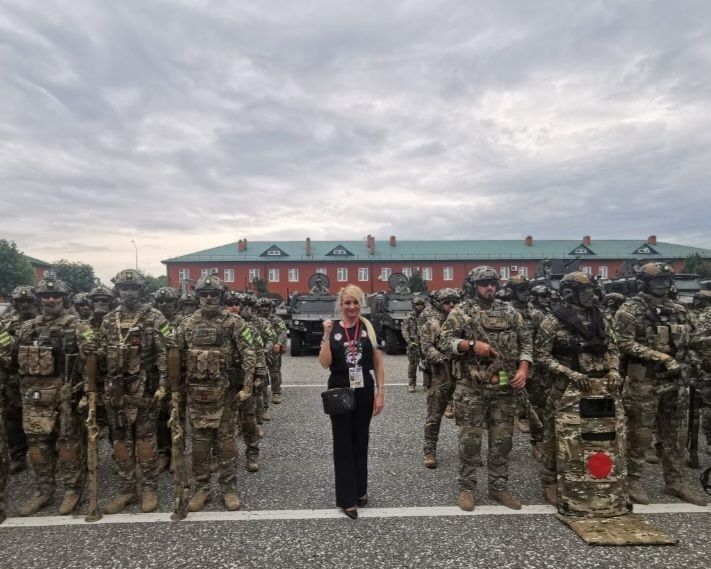
Moreover, Trifković is the author of articles that whitewash Putin and threaten Europe on Russia's behalf. In short, there is no depth of disgrace left for her to sink to… I earlier wrote on RISU: “Metropolitan Luka's cooperation and like-mindedness with the Russist Trifković are close. He took part alongside her both in a Bulgarian conference in 2024 and in another conference, which she organized in Belgrade, in March 2025.” And in his own presentation in December 2025, Luka openly proposed, as a model for an analytical center tracking ecumenical and geopolitical threats, precisely the structure run by this — in essence — pro-Russian war agitator.
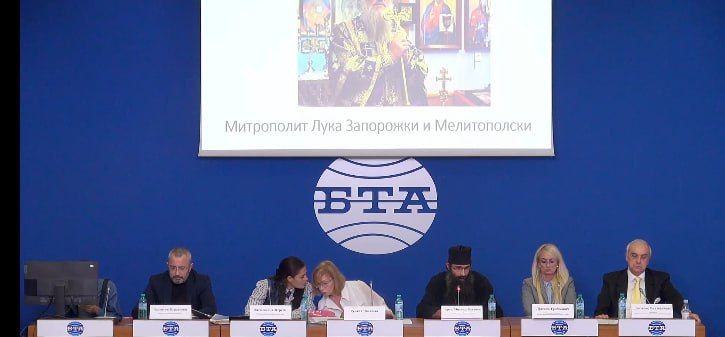
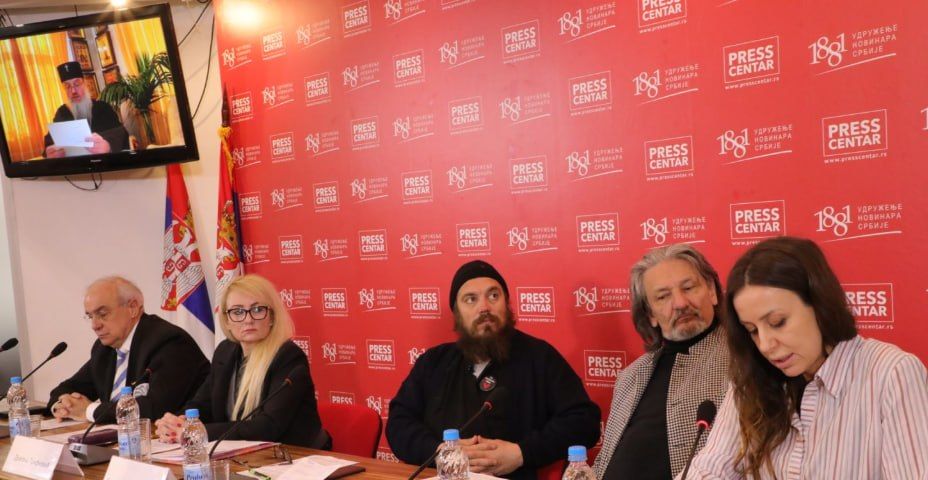
There is also a full video recording online of the conference held on April 30, 2026, under the auspices of the Center headed by Trifković. It was at this very conference that the council mentioned above was founded. The announcement accompanying the YouTube video confirms, in black and white, that the initiative to create it belongs to Metropolitan Luka.
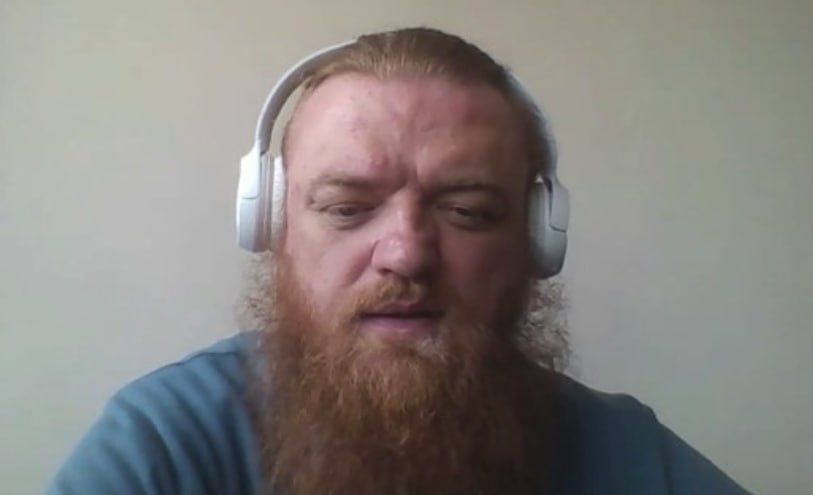
And now, pay attention! The first speaker to whom Dragana gives the floor, after her own opening address, is Ruslan Kalynchuk — a “journalist” for the notorious outlet “Pershyi Kozatskyi,” who is wanted by Ukraine's Security Service (SBU), and who today works openly on the Russian ideological front. There he is referred to as a “catechist,” a “missionary,” a “preacher,” and even a “philosopher.”
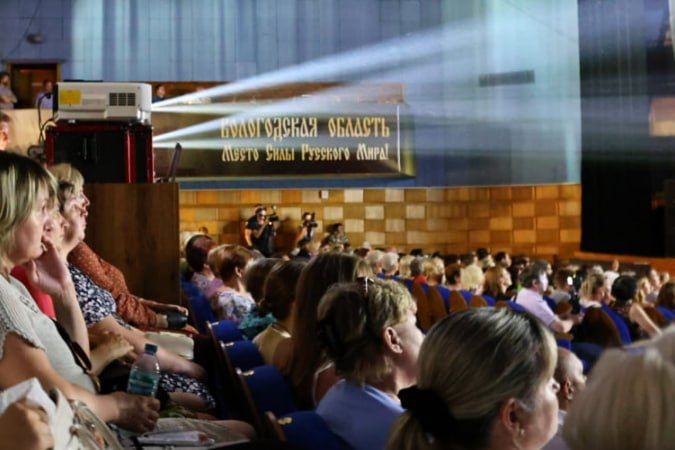
In July 2025, he was given the “honor” of moderating a propagandist forum in Vologda, where Putinists and supporters of the war against Ukraine gathered. Among them were ROC dignitaries, including Metropolitan Tikhon Shevkunov — for many years a man very close to Putin, and now a ROC church hierarch in occupied Crimea. Also speaking there was ROC Archbishop Marchel of Moldova, known for his “human-rights” activity in Western international organizations, which he combines with solidarity participation in the covens of the “Russian world.” There were others too: Sergei Glazyev, state secretary of the Union State of Russia and Belarus; and top propagandist Nikita Mikhalkov, among others. The ROC's website reports that Patriarch Kirill blessed the event. They also brought in the Serbian director Emir Kusturica, a Putin supporter.
There is a particular cynicism here: the event was held under the title “People of Christ. Our Time” — the same title as the propaganda film screened there. And naturally, in the forum hall, where they discussed how to forge “victory” on the battlefield and on the home front, a banner loomed (I give it in the original): “Mesto sily russkogo mira” [“A Place of Power of the Russian World”].
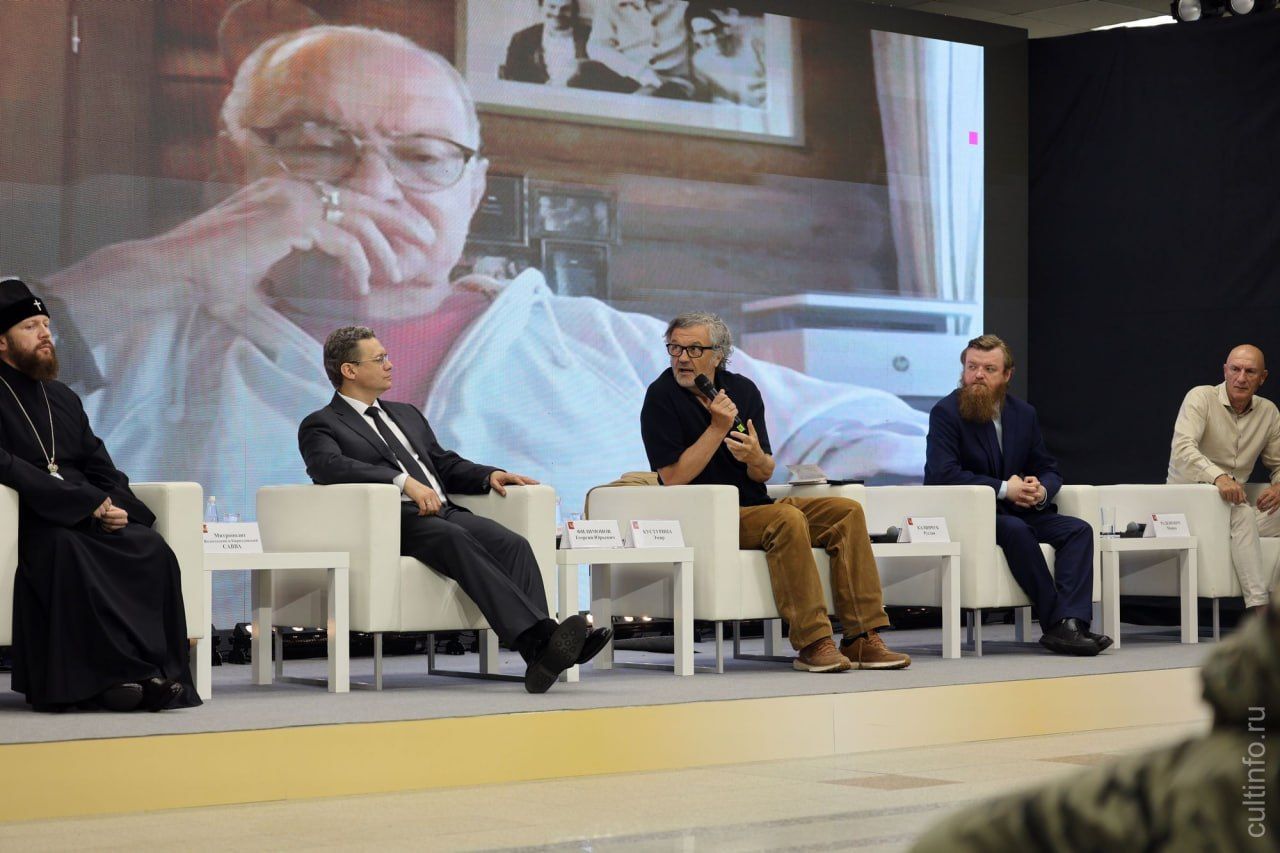
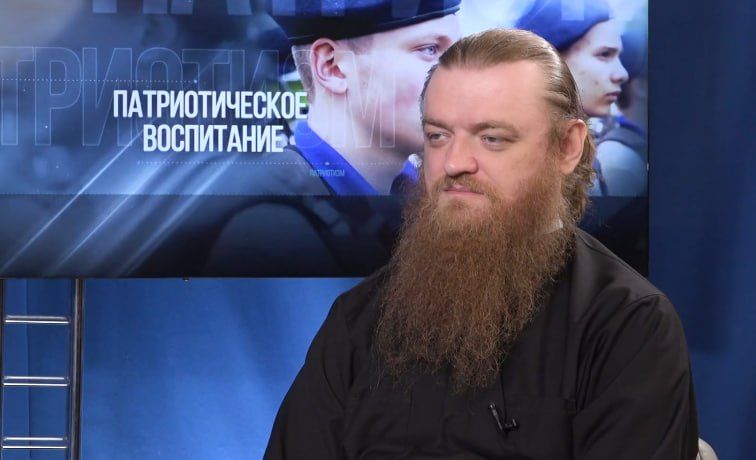
To round out the portrait of Ruslan Kalynchuk, let me add one more telling quotation: the announcement for an interview with him on April 14, 2026, on the Odintsovo Information Center: “Orthodox missionary Ruslan Kalynchuk. In his homeland, in the western regions of Ukraine, five criminal cases have been opened against him, and under some of the charges, he faces life imprisonment. Ukraine's authorities accuse him of collaborationism and treason. Kalynchuk himself claims he is being persecuted for his convictions: he has publicly spoken about pressure, arrests, and beatings of priests of the canonical Ukrainian Orthodox Church. Ruslan Vasylovych is not a priest but a layman. Yet he received the personal blessing of the ruling hierarch, Metropolitan Foma, to preach. Such a case is rare, since in church tradition this right almost always belongs to the clergy. You can hear his sermons every Sunday at St. George's Cathedral in Odintsovo [a town in Moscow region]. Host Timur Gaisin spoke with a man who knows the causes of the special military operation firsthand, not by hearsay. This conversation is a rare chance to hear the voice of someone who saw the situation from the other side and was able to look into its very essence. You will learn what he did in Kyiv, what forced him to flee, what it is like to have an entire state as your enemy, and why, despite everything, he firmly decided to devote his life to God and the Church.” In that interview, Kalynchuk says: “WE are carrying out a special military operation,” fully consciously identifying himself with Russia's war crimes…”
And so we come to Metropolitan Luka Kovalenko — the initiator of the International Council for the Protection of Orthodox Canonical Order. It is clear that this is, in reality, a Russist lobbying center, founded at the very conference where the first word was given to Ukraine's state traitor Kalynchuk. Kalynchuk is evidently one of the council's key members, as is presumably Dmitry Belyakov, a Lukashenko propagandist and approver of Kremlin actions, who was also among the conference's speakers. On the Center for Geostrategic Studies website, we can also find the full text of Kalynchuk's presentation, “The Destruction of the Church in Ukraine as an Element in Shaping a New Geopolitical Reality.” There is no point in analyzing it in detail. Still, it is telling that he begins by firmly emphasizing the UOC's status as an autonomous body within the jurisdiction of the Moscow Patriarchate.
And further in his presentation, Kalynchuk — a native of Ivano-Frankivsk — unleashes waves of obsessive rage against the Euromaidan and against the Ukrainian Greek Catholic Church (UGCC) and its leaders, in particular Hierarchs Sviatoslav Shevchuk and Borys Gudziak. Kalynchuk demonizes the Vatican and attributes to it a plan for a modern reconstruction of empire along Habsburg lines. To quote him: “The Vatican is trying to realize in Europe a project resembling a new Austria-Hungary, into which, preferably, all of Ukraine would be absorbed. The realization of such a plan is impossible, given the significant Russian-speaking and Orthodox population. For this reason, the Vatican had to bring to power people loyal to itself, clearing the political space of forces representing an alternative course, and to destroy the last link connecting the peoples of Russia and Ukraine — the UOC. It should be noted that they succeeded in much of this: after the Maidan, people connected with the Ukrainian Catholic University (UCU) or with other structures of the Ukrainian Greek Catholic Church came to power in Ukraine — Uliana Suprun, Nataliya Yaresko, Andriy Yurash. President Petro Poroshenko also took communion in Uniate churches. All these people became the enforcers of the harshest struggle against the UOC. But the matter did not end with the Uniates alone, since Catholicism remains foreign to the majority of Ukraine's population. So it was decided to use a strategy of substitution: in 2018, as a result of the utterly criminal, anti-canonical actions of Constantinople Patriarch Bartholomew, the so-called Orthodox Church of Ukraine (OCU) was created — a schismatic, sectarian, nationalist organization. But in the creation of this structure, an active role was played not only by Patriarch Bartholomew and Ukrainian President Poroshenko, but also by the US State Department.”
This scarcely needs comment. And there is no reason to doubt that Metropolitan Luka Kovalenko is of one mind with people like Kalynchuk. After all, the format of the conferences and round tables held by Dragana Trifković's Center, or of forums like the one in Vologda, is not one in which alternative, differing positions and approaches compete. It is a monolith of ideological like-mindedness. They do not debate among themselves; in unison, they parrot Russist propaganda tracts against the free world and the humanistic forces within contemporary Christianity.
It is worth noting: in one of his other addresses (at a conference in Moldova in August 2025), the Zaporizhzhia metropolitan strongly supported the activity of ROC Archbishop Marchel, who in September 2025 lobbied for the Gundyaev structure's interests before UN bodies in Geneva — shortly after having been one of the speakers at the “Russian-world” forum in Vologda. And the puzzle once again fits together neatly: in an interview for Život Crkve, Luka states outright about the systematic actions of ROC supporters on the international stage: “There is resonance at the UN. Appeals and lobbying have led international institutions to begin reacting more firmly. For instance, UN experts (OHCHR) have expressed serious concern about Kyiv's actions toward the UOC, including the stripping of citizenship from certain hierarchs and the risks associated with implementing the law ‘on the prohibition of religious organizations linked to the aggressor state.'” In other words, the network of lobbyists for Russian interests is, to a greater or lesser extent, partially achieving what it seeks.
And now the question arises: can the Ukrainian state, in the fifth year of the war, really afford the “luxury” of allowing residents who are openly collaborating with the aggressor state and its ideological machine (the ROC) — which, through pseudo-sacred “meanings,” blesses the mass killing of Ukrainians — to carry on active public, including international, activity? And this in circumstances where Metropolitan Luka, in fact, wields significant public influence in Ukraine. Here are some signs of that influence. He has the backing of the UOC's primate, Metropolitan Onufriy (attested by laudatory greetings addressed to him by Onufriy in 2025). He has his own YouTube channel and resources on other social networks, through which he influences Ukrainian citizens during the war. He also edits one of the UOC's regular official newspapers (“Letopis Pravoslaviya”), published monthly (mostly in Russian). Its pages abound with promotion of the legacy of the “Russian world,” as well as of contemporary figures who support Putin (for example, almost every issue contains sympathetic coverage of the activities of Serbian Patriarch Porfirije, who, as is well known, calls Putin a guardian of Christian values and fully endorses his policies). In particular, even the very latest (May 2026) issue of “Letopis Pravoslaviya” features a special piece on the decisions of the Serbian Church's Bishops' Council under the leadership of the Putinist Porfirije. The headline is telling: “The Serbian Church Once Again Raises Its Voice in Defense of the UOC.”
In the end, is Luka the only one carrying out such pro-Russian activity within the UOC? Of course not. This is a system. For example, one of the official resources within the UOC's information network is the Tulchyn Diocese website. There, to this day, among the leading figures held up as examples of Orthodox devotion, one still finds Metropolitan Ionafan Yeletskykh, who nowadays conducts active pro-war, anti-Ukrainian propaganda in Russia. But that is a separate story, and we will tell it in more detail about Yeletskykh in another article.
##DONATE_TEXT_BLOCK##