
Researchers reconstruct 42 missing pages from ancient New Testament manuscript


This is not a new or previously unknown biblical text, but rather reconstructed fragments of an ancient manuscript that help us understand how Christian texts were read, copied, and used many centuries ago.
Codex H is a 6th-century manuscript containing the Epistles of the Apostle Paul. In the 13th century, it was dismantled at the Great Lavra monastery on Mount Athos. Individual sheets from the manuscript were reused as materials for book covers and inserts in other books.
As a result, the preserved fragments are now scattered across libraries in various countries, including Italy, Greece, Russia, Ukraine, and France.
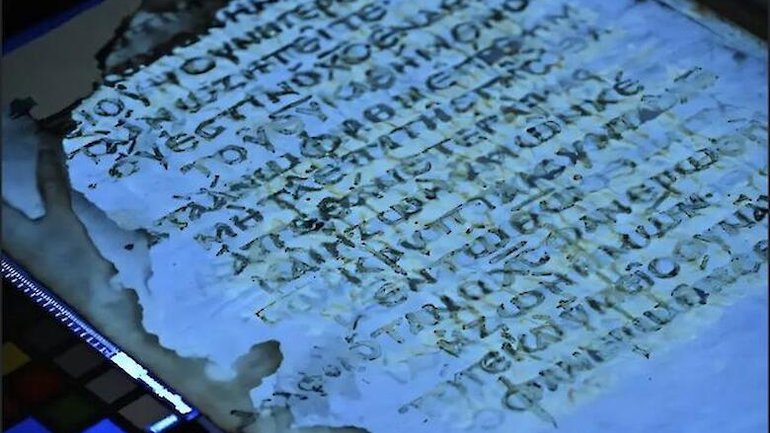
A team from the University of Glasgow was able to reconstruct 42 lost pages thanks to a unique feature of the manuscript. At some point, the text was traced over with ink, which left faint mirror images on the adjacent pages — a "ghost" text of sorts.
To the naked eye, these traces are almost invisible. However, using multispectral imaging, researchers managed to read what had not physically survived as individual pages.
Additionally, experts conducted radiocarbon dating of the parchment, confirming that the manuscript dates back to the 6th century.
This discovery is significant because it reveals early insights into the manuscript's copying and use. The reconstructed pages help us understand:
- What the manuscript looked like before it was taken apart
- How scribes corrected and annotated sacred texts
- How Paul’s Epistles were divided into thematic sections in ancient times
- How old religious books were reused in the Middle Ages
The ancient chapter lists for Paul’s Epistles are particularly important, as they differ from the modern division of the text and illustrate how early readers structured these books.
The discovery was reported by the University of Glasgow, and the research was conducted by an international team led by Professor Garrick Allen.