
Unmasking evil is the first step in overcoming it – Myroslav Marynovych at the conference in Rome


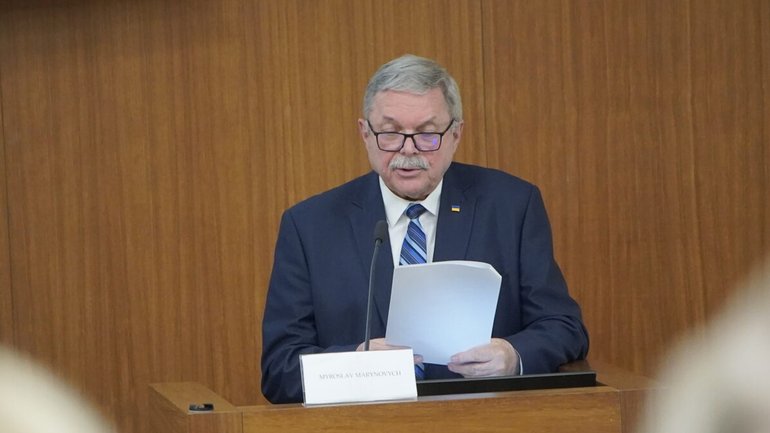
Here is the inaugural presentation at the conference by Myroslav Marynovych — Rector’s Advisor UCU, s a human-rights defender, civil activist, founding member of the Ukrainian Helsinki Group, dissident and former political prisoner.
A Theology of Hope for and from Ukraine
Distinguished Audience, dear brothers and sisters in Christ!
Christ is Risen!
I am truly honoured to deliver this keynote speech to you, and I sincerely thank the organisers for this invitation.
The key word in the title of our conference is “hope,” and for Ukrainians today, there is no more important word. That is why it is so significant for us that the Bishop of Rome has once again declared 2025 the Jubilee Year of Hope. The more we waver in our hopes for a just end to Russia’s aggression against Ukraine, the more we rely on the words of Jesus: “With men this is impossible, but with God all things are possible” (Matthew 19:26). And, as His Beatitude Sviatoslav, Head of the Ukrainian Greek Catholic Church, reminded us in his address “Jesus Christ is our hope,” St John Chrysostom taught: “The devil sends us thoughts of despair in order to destroy our hope in God – this safe anchor, this pillar of our life, this guide on the road to heaven…”.
So, in keeping with the title of the conference, I will speak first about the theology of hope for Ukraine and then about the theology of hope from Ukraine.
A theology of hope for Ukraine
Political connotations of the theology of hope for Ukraine
Russia continues its war against Ukraine, and therefore the attention of all Ukrainians is focused primarily on the war theatre. It is the military and political news that makes us either hopeful or disappointed; feeling grateful or abandoned. Therefore, the theology of hope for Ukrainians has distinct political connotations. After all, we are facing a truly existential challenge: Putin’s regime has publicly set itself the goal of completely destroying the Ukrainian state, Ukrainian identity, and Ukrainian churches, and it does not hide the fact that for it the “final solution to the Ukrainian issue” is to deny the very right of Ukrainians to exist.
That is why with great foreboding we observe the emergence of options for a “peace” agreement that provide for Ukraine’s complete surrender, with the Putin regime not only not being held accountable for its crimes, but even having sanctions against it lifted. Such scenarios would include new Chamberlains who again proudly exclaim to their voters: “We have brought you peace for our time!”.
But in reality, this would doom the world to an endless repetition of tragedies. In the early 1990s, we dissidents of the Soviet period were sincerely persuaded by our Western colleagues that calls to organise Nuremberg II would be harmful, that we should simply draw a line and start with a new beginning not dwelling on the past. The various arguments were often highly moral, but in reality, their reasoning was based on fear of the possibility of turning the Eastern European space into a mess of military conflict. Well, in 1991 this was avoided. But the bloody mess of 2022 has reminded us that unpunished and unredeemed crimes, like weed seeds left in the ground, produce new and terrifying shoots. Indeed, Putin has turned his regime into a reincarnation of the Chekist regime of the previous communist empire. He has brought Russia back to the phantoms of its past, as `few in its history have been punished for their crimes. Therefore, Dostoevsky’s famous phrase “Crime and Punishment” hangs over this country like a sword of Damocles.
Absolving Russian aggressors from responsibility for the sake of a sham peace would turn our Сhamberlain’s “peacemakers” into Jeremiah’s prophets, who “heal the wound of my people lightly, saying, ‘Peace! Peace!” when there is no peace” (Jer. 8:11).
Russia’s war against Ukraine has caused too much suffering for us Ukrainians to stand idly by as Western democracies fall back into old historical traps. Our goal is not to criticise the West from a position of supposed righteousness and infallibility, but to warn the West based on our bitter experience. We want to ensure that we do not hear again from Western leaders what we heard from German President Frank-Walter Steinmeier, who said back in April 2022:
We failed on many counts. It is true that we should have taken the warnings of our Eastern European partners more seriously, especially regarding the time after 2014.
Therefore, the laying bare of the false visions of the world that the current war has illuminated with its fiery light opens a window of hope for Ukraine.
Unmasking evil is the first step in overcoming it
This war caught the postmodern world in a state of deep complacency. Postmodernism has not only denied the existence of absolute goodness or virtue, it has also denied the ontological essence of evil. In fact, many Christians today read the New Testament with its numerous references to the embodied devil, but they do not actually believe them. For there seems to be no ontological evil, and Jesus was not tempted in the desert by the embodied devil, but by his virtual image.
The evangelist Luke states: “Satan entered Judas, whose name was Iscariot ” (22:3). So, since the beginning of this war, Ukrainians perceive these words not as a polemical exaggeration, but as real action of the embodied devil. For Ukrainians ‘see this devil almost every day in the Russian torture chambers of Bucha and Mariupol, in Russian concentration camps for prisoners, in the bombing of children’s hospitals and maternity wards.
War raises a tough question for humanity: “Do we understand evil correctly?” If evil is not a subject of destructive action in this world, but only a mirage created by the mismatch of interests of participants in competitive interaction, then it will not be noticed. And even if it is, it will not be taken seriously and will not be opposed. As a result, the human community may become defenceless against evil because it will not believe in its existence. Consequently, it will look for a supposedly logical justification for evil.
Or another problem. At the beginning of this war, the theme of brotherhood dominated the rhetoric of many Europeans: “You, Ukrainians and Russians, were brothers – what is it that prevents you from reconciling again?” Ukrainians responded with pain: “Well, Abel and Cain were also brothers.” I will allow myself to develop this Cain parallel a little bit, because, in my opinion, there is at least one important point in it.
We see God’s willingness to hear the voice of the victim – “What have you done? Behold, the voice of your brother’s blood is calling to me from the earth” (Genesis 4:10). In other words, Christians should also look at the conflict through the eyes of the victim. This is exactly what the Synod of Bishops of the Ukrainian Greek Catholic Church say in their message entitled “Rescue the oppressed from the hand of the oppressor”:
Ukrainians do not question the importance of soberly weighing threats and carefully calibrating political steps. However, it is important to maintain the ability to look at current events through the eyes of a victim.
This ability to do so, in my opinion, is the main precondition for unmasking evil. At first, evil dons a mask of virtue, and when it comes to the conclusion that the time has come for its victory, it takes off this mask and appears naked before humanity. And then it can be recognised even by those who have lost the ability to distinguish between good and evil. And this opens a window of hope for Ukrainians.
Spiritual aspects of security imperatives
The world knows the classical principle of justice: “Punishment must be inevitable” — but unfortunately, political logic often contradicts it. Today, the thought of punishing Russia causes a quiet panic in the West. Ukrainians have failed to convince them that, instead of rejecting the possibility of Russia’s collapse a priori, it is better to make it a ‘controlled collapse. Many Western politicians prefer to keep Russia “afloat” in order to preserve the current geopolitical balances and prevent the rise of China.
There is one more reason for the West to be cautious: Russia’s collapse could result in nuclear weapons falling into the hands of terrorists. But isn’t Putin a terrorist? Are the ruins of Ukrainian cities less stunning than the ruins of the Twin Towers of the World Trade Center? And isn’t Putin blackmailing the world with nuclear weapons? So what is the difference between Putin and Osama bin Laden? The only difference is that Putin has a nuclear button under his fingers. The situation is repeating itself from 1991, when George Bush, junior and Margaret Thatcher appealed to Ukrainians not to resort to “destructive nationalism” and not to seek the collapse of the USSR, as this threatens a loss of control over a nuclear arsenal. Today, the West, even while opposing Russia, is not letting Putin’s regime fall.
Therefore, hope for Ukraine will open when the world finally develops its own credible vision of how this war should end. Putin has not changed his attitude towards Ukraine one ióta [ai’əʊtə]: both the Ukrainian state and the Ukrainian nation must disappear. Therefore, we have three possible options.
The first assumes that Western democracies will completely abandon their values. After all, if the West decides to prevent Russia’s collapse at any cost and reconcile with it, it must tell itself frankly that it is ready to accept another “final solution to the national question,” only this time not the Jewish one, but the Ukrainian one. In this case, peace would be restored through the almost ritualistic death of the “scapegoat” that Ukraine is to become. What would then be left of the West’s ethical framework?
The second option is to postpone the resolution of the Russian issue “for later.” In this case, Ukrainians would be doomed to a repeat of Russian aggression under a better-thought-out pretext.
Finally, the last option involves clear understanding that a just peace is not achieved at the cost of denying the truth and at the cost of ethical defeat. The prophet Isaiah [ʌɪˈzʌɪə] describes the prerequisites for sustainable peace and tranquillity: “Peace will be the work of justice, and the fruit of righteousness will be peace and security for ever” (Isaiah 32:17). In the first half of the twentieth century, Metropolitan Andrey Sheptytsky, who lived through two world wars, also said:
For everyone understands that a peace that does not take into account the needs of peoples and in which peoples consider themselves offended and indeed are, would not be any peace, but rather a cause of new and worse complications and mutual hatreds that would have to lead to new wars.
And Bishop Desmond Tutu put it simply: “If you remain neutral in situations of injustice, you have sided with the oppressor.”
Therefore, the Church must warn society against excessive trust in security imperatives formulated by political logic.
And now – about the “theology of hope from Ukraine”
Ukraine is not only a problem but also a solution
Being an enslaved nation in the past, Ukrainians have naturally experienced an inferiority complex for a long period of time. So it came as a pleasant surprise to many of us that Ukraine itself could become a source of hope. After all, as stated in a February, 2025 address by the rectorate of the Ukrainian Catholic University,
…and the third year of this terrible war has become an impressive miracle of our resilience and invincibility. And only God knows where our exhausted defenders draw their strength from to hold the front and continue to repel the enemy. We are confident that the day will come when all these seemingly small and unnoticeable achievements will merge in our minds and in the minds of the whole world into one great Miracle that the Lord has revealed to our suffering people and which could not have been realised if Hope had not been burning in our hearts.
If my comrades who died in Brezhnev’s labor camps could see today’s Ukraine, they would undoubtedly be filled with pride in the people’s current ability to defend themselves.
For a long time, the world did not believe in Ukraine either. In the eyes of Europeans, Kyiv was like that unattractive Nazareth from which nothing good could come (cf. John 1:46). Until recently, Ukraine was perceived as a troublemaker in the world, and it seems that the Trump administration is now of the same opinion. However, I share the conviction of the Ukrainian historian Yaroslav Hrytsak that “Ukraine is not only a problem, Ukraine is also a solution.” But to see this, we need to adjust our perspective.
In an effort to survive, Ukraine appeals to the world in the language of values, and this is the language that will inevitably replace the language of national selfishness that has become so popular today. After all, the logic of national selfishness will inevitably lead to a new global conflict, as has happened many times in human history. Therefore, Ukraine’s sacrificial testimony gives hope that such an ending can be avoided.
The War in Ukraine and Catholic Social Teaching
An interesting feature was noticed by Ukrainian Metropolitan Borys Gudziak of Philadelphia, who has repeatedly argued that Ukraine’s response to this war in its valor and effectiveness reflects the basic principles of Christian social teaching.
Indeed, during this brutal war, the resilience of Ukrainians would not have been possible if it were not for the fact that they de facto adhere to the principles of social teaching. Until recently, an internally divided nation has shown amazing solidarity, which allows them to overcome fear and build a ‘life amidst the ruins, that is, not to despair.
A conscious sense of subjectivity (subsidiarity) allows us to feel our God-given dignity and not to perceive ourselves as a grain of sand on which nothing depends. Ukrainians’ assertion of their right to self-determination and free choice of partnership serves as a powerful counter to the resurgence of block thinking, which in the past deprived the so-called “small” or “unimportant” peoples of their voices.
However, it seems that at the moment there is some ambiguity as to how Catholic doctrine evaluates concepts such as “just war” and “just peace.” In Catholic practice, there has long been a tendency to replace the former term with the latter, but as it turned out during the current Russian-Ukrainian war, the concept of “just peace” cannot adequately answer all the problems that arise.
In particular, we are talking about the supply of lethal weapons. It cannot be concealed that Ukrainian society was shocked by signals from some parts of the Catholic world questioning the supply of weapons to Ukraine. These signals sounded to Ukrainians like a denial of their right to self-defense. After all, the need for modern weapons capable of stopping the aggressor is perhaps the most important practical need of Ukraine at this time. If this need is not met, Ukrainians ask, how can we mourn the suffering of the victims of this war? After all, Putin’s regime has publicly set itself the goal of the “final solution to the Ukrainian issue” which means the denial of the very right of Ukrainians to exist.
In a personal encounter in June of 2022 with Pope Francis of blessed memory I posed this question to the Holy Father: do we have a right to defend ourselves. Pope Francis answered: “Not defending oneself in such circumstances is akin to suicide.”
In 2001, I participated in the Synod of Bishops of the Catholic Church as an auditor and witnessed how consensus on difficult doctrinal issues was reached. Therefore, I personally look forward to Pope Leo XIV convening an extraordinary Synod of Bishops to discuss and clarify the ambiguous or ambivalent doctrinal issues of war and peace. I am confident that the circumstances of the heroic defense of Ukrainians will provide an important impetus for clarifying Catholic social teaching.
Therefore, the resilience of Ukrainians who rely on international law and create space for the restoration of the world order through their self-sacrifice is simply another facet of hope.
Peacekeeping vs appeasement of the aggressor
Very often, peace is perceived in the world as the absence of war, and therefore many polititians seek to reconcile us with the Russians as soon as possible. But let’s think about what, based on Christian social teaching, the Dean of the Faculty of Philosophy and Theology of UCU, Fr Yurii Shchurko writes:
Peace is a consequence of God’s order… Peace is not the absence of war, but a positive concept with its own content… God’s peace is not compatible with evil! One cannot tolerate sin and speak of God’s peace. God’s peace is always the fruit of renunciation of evil and union with God…
Therefore, Christian social teaching clearly states that Christians should preach a peace based on truth and justice. This is based on the words of the prophet Zechariah: “This is what you must do: speak truth to one another, judge righteously, so that peace may be at your gates” (Zech. 8:16).
We Christians know an unambiguous imperative in the Sermon on the Mount: “Blessed are the peacemakers, for they will be called sons of God” (Matthew 5:9). There is no doubt: these words are the quintessence of Christianity. But do all peacemaking efforts contribute to the establishment of God’s peace? After all, the terms “peacemaking” and “appeasement of the aggressor” are not interchangeable synonyms! Therefore, it is important to correctly resolve the famous dilemma of “security vs. values.”
The more war crimes Russia commits in Ukraine, the more weighty the ethical arguments become in assessing the events. It is impossible not to notice that the world has lost at least 11 years trying to appease the aggressor. However, this seeming peacefulness is precisely the dangerous trap: ignoring values brings about such disturbances in the world that endanger the very thing that is sought to be protected, namely security. And we invariably find confirmation of this: today we are closer to World War III than in 2014.
So the hope from Ukraine today is that Ukraine reminds the world of the indisputable importance of values for the establishment of sustainable peace. Not because Ukrainians are righteous, but because they comprehend the realities of this war from the perspective of a victim.
Overcome despair with hope
Yet even here, under this ominous and concentrated threat, there is hope, because for Christians, the time of paradigm change does not have to be a final curse. In the New Testament perspective, this is a time that is, on the contrary, full of hope: “I am the Alpha and the Omega, the beginning and the end,” says the Lord, “I will give to the thirsty man of the fountain of life” (Rev. 21:6).
So, Ukrainians want to see the current crisis not as God’s punishment, but as God’s mercy, because this crisis can turn into a huge chance that will save us. And I am led to this conclusion by the Apostle Paul’s seemingly paradoxical formula: “But where sin has abounded, grace has also abounded” (Romans 5:20). This time is psychologically very difficult to live through, because evil looks omnipotent and invincible. However, according to the Apostle, the dominance of sin should not lead to a loss of faith in the victory of God. For it seems that the increase in sin is evidence that somewhere in the invisible epicentre there is an intense increase in grace. In this way, the omnipresent and seemingly all-conquering entropy (the growth of chaos) is overcome by the creation of a new order.
An interesting pattern has long been observed: the more values decay in the world, the closer we are to the moment of a complete reset of the value platform. This is the way the Lord’s “hand” works, which periodically cleanses the earth “from all filth.” Let us recall the “hour of Satan” at the Passion when Evil briefly gained power over the Son of God. It would seem that Satan’s victory was certain: “I will strike the shepherd, and the sheep will scatter” (Matthew 26:31). But this victory was in fact specious, because at that very moment, through the voluntary sacrifice of Jesus, God “grew the crystal” of the new world order, the New Creation. And we have direct confirmation of this in Revelation: “Behold, I make all things new” (Rev. 21:5).
So let us not despair of the current rampant “time of Satan.” Let us believe that behind it is the creation by God in some invisible place of a new solution for the world – a new security system in international relations. And from the fact that Evil is so intent on destroying Ukraine, I assume that it is in Ukraine that this discernment is being matured. Therefore, the present era is not a time of despair, but one of true hope.