
Freedom of Faith in Belarus: How to Preserve Independence Under Total Oppression


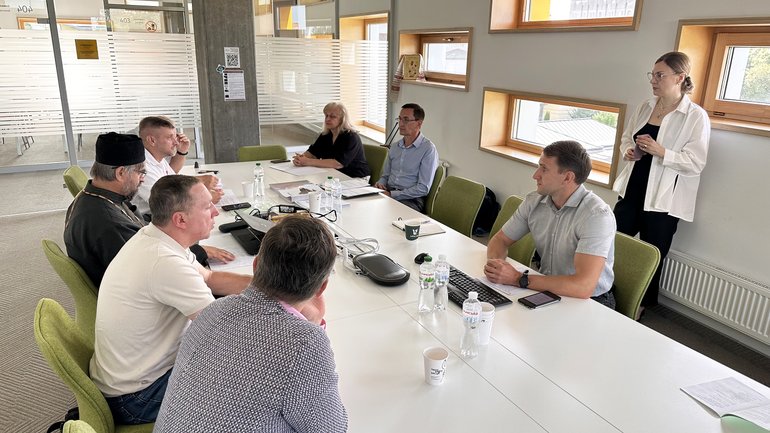
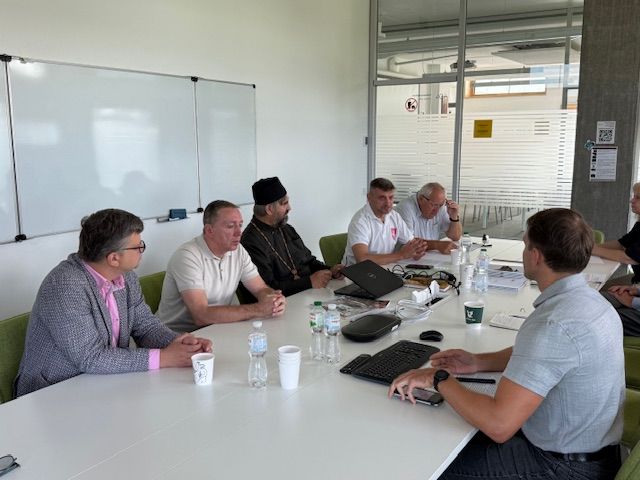
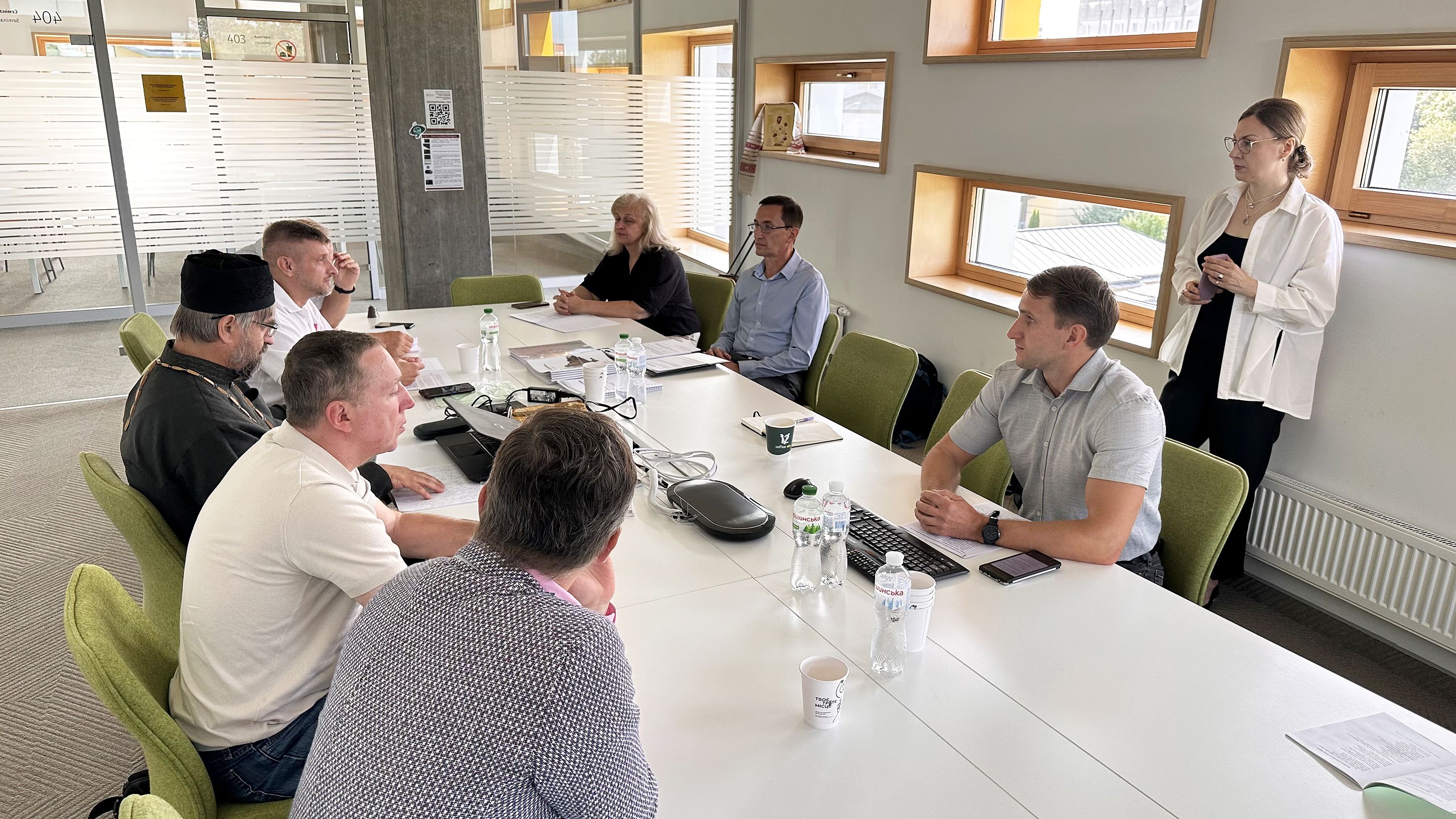
What is happening in totalitarian Belarus? Why must people leave their homeland in order to work for their own nation? Is it truly possible to escape the grip of the Russkiy mir (“Russian World”) and the authoritarianism of Alexander Lukashenko? These questions were at the center of the recent discussion “Religious Freedom in Belarus” held at the Ukrainian Catholic University.
The event was organized by the Free Belarus Charitable Foundation and the UCU Analytical Center.
Belarusian journalist, opposition figure, and human rights defender Andrei Myadvedev of the “Viasna” center noted that priests in Belarus either become targets of persecution or instruments for implementing the state ideology of the self-proclaimed president Alexander Lukashenko. A few years ago, a new law was passed requiring all religious organizations to amend their statutes to include provisions on incorporating state ideology into their activities. Those unwilling or unable to comply became subject to persecution.
In 2024 alone, according to Belarusian human rights groups, 15 priests were repressed, detained, arrested, or imprisoned. These are only the confirmed cases. The reasons varied — one of them was simply paying for Ukraine during Russia’s full-scale invasion.
“The Belarusian Exarchate — the Church that operates under the wing of the Moscow Patriarchate — has nothing Belarusian in it. It should be called a branch office of the ROC. Russia’s influence here is enormous. This ROC affiliate in Belarus, let’s call it that, enjoys privileges in every sphere of activity. Meanwhile, the independent BAOC is not registered at all. Priests who served in Belarusian, who spoke in Belarusian terms, are now either persecuted or have left the country,” said Myadvedev.
In Belarus, there is no freedom at all. The Declaration of Human Rights is openly violated, and defending one’s rights is virtually impossible. In terms of religious oppression, an example is the forced re-registration of churches, which leads to persecution and discrimination, particularly against Protestants. Even during the 2020 protests against Lukashenko’s presidency and the disputed elections, riot police went after pastors.
“Everything in Belarus is broadcast through a Russian lens — including the war in Ukraine. Children deported from Ukrainian territories are brought into Belarus. So-called ‘re-education camps’ are organized there. The same narrative is repeated: Ukrainians are Nazis, Banderites. Through the ROC’s Belarusian branch, a process of reprogramming the new generation is underway, preparing children for war against Ukraine. In some schools, Saturday ‘classes’ have been introduced, during which priests give lessons. Needless to say, this is Russian propaganda,” added Myadvedev.
Anatolii Babynsky, Doctor of Theology, lecturer, and researcher at the Institute of Church History at UCU, draws parallels with Ukraine. The UOC–MP identified itself very differently in different regions. In Crimea, churches displayed signs declaring their affiliation with the Moscow Patriarchate. In Kyiv, they used only “UOC.” In Zakarpattia, priests might omit commemorating Patriarch Kirill during the liturgy and make no mention of the MP at all. Clearly, this was a tactic to preserve the Moscow Patriarchate's presence across regions, regardless of the label. In Belarus, however, the opposite is required: strict uniformity.
Although Lukashenko does not tolerate separatist tendencies and firmly supports Russia in matters of the church, some clergy would like to see greater independence. Any such sentiment is swiftly suppressed, often through changes in legislation.
Father Yevhen Orda, rector of the Church of St. John the Warrior (OCU) in Chernihiv, is an ethnic Belarusian. He serves as a chaplain, has endured captivity, and continues to visit the front — while also caring deeply about his parents’ homeland. According to him, there are far more Catholics in Belarus than is usually acknowledged. There may be fewer parishes, but they are enormous.
“I visited before the war, so I can compare. In addition to building communities, Catholics look after their churches, construct new ones, and receive support from Poland. Orthodox churches, by contrast, are often in poor condition. Both Roman and Greek Catholics had great potential, but Lukashenko sees their work as a threat. The Belarusian Orthodox Church is not a church of Belarusians, but a church of occupation. And the country has a peculiar policy: the Moscow Patriarchate pressures Catholics to serve only in Polish if they refuse Russian. In other words, if you don’t want to be Russian, you must be Polish. They divide people. For the future, they do not see Belarusians as a nation or a culture — only as a fragment of Russia. Before 2020, there was a strong revival of church life and conscious youth. Now the Belarusian Exarchate of the MP is erasing every trace of Belarusian national identity.
In Chernihiv, we have many ethnic Belarusians and mixed families. We constantly explain to relatives what is really happening, and we care deeply for Belarusians. I believe real change requires a strong diaspora. Ukrainians had one, and this helped preserve both the Greek Catholic and Orthodox Churches abroad, which later returned and contributed to reviving the nation. That is why today the Belarusian Christian diaspora must do everything possible to make national revival possible in the future.”
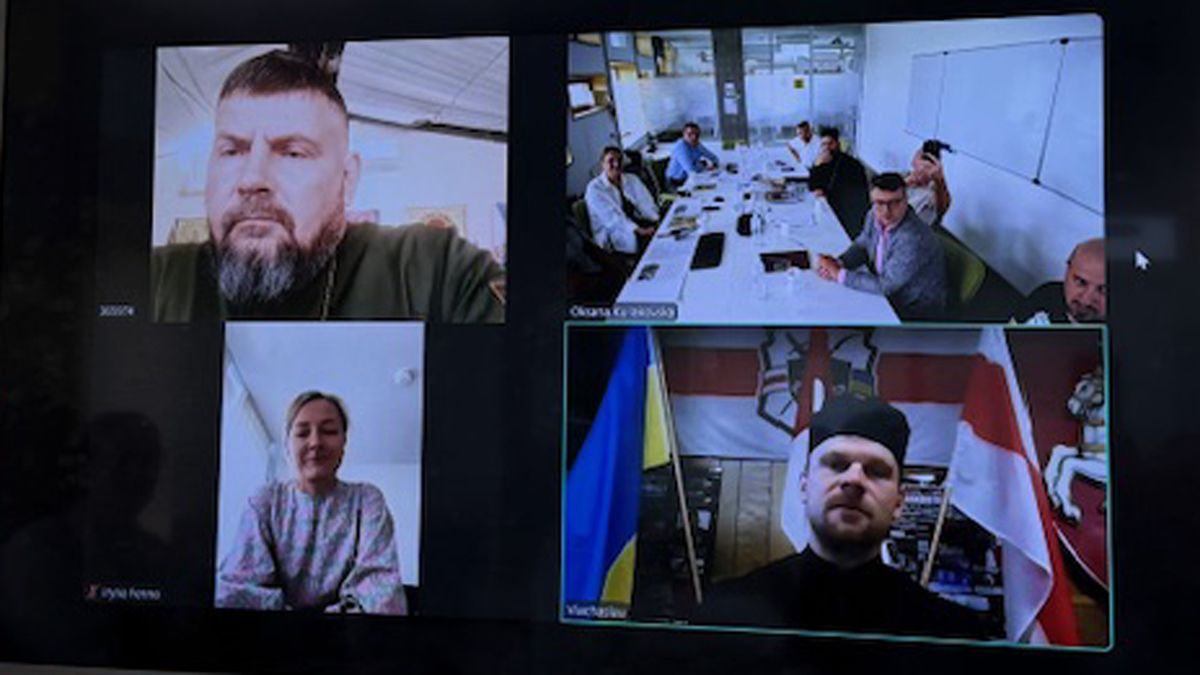
Archbishop Sviatoslav (Login), Primate of the Belarusian Autocephalous Orthodox Church, says that their confession is the only one not registered in modern Belarus. Since the 1990s, attempts have been made to change this, but without success. In Ukraine, the Orthodox Church received autonomy in 1990; Belarusians, however, were given no freedom at all. When the question of autonomy arose again in the early 2000s, Moscow refused and told them not to raise the issue again for the next 50 years.
“The re-registration of churches is aimed only at labeling the Russian Church as Belarusian. However, our priests still remain in Belarus and hold services, albeit rarely. The KGB definitely monitors them, sometimes detains them, or takes them away somewhere. But they try not to arrest them outright, so as not to create publicity. Our underground Church has become even more underground.”
Belarus is experiencing a spiritual decline, particularly among the youth. People see that the Belarusian Church is under Moscow’s control and cooperates with the authorities. Meanwhile, Lukashenko had only 10% support even during the elections — and that figure has not grown since. People are becoming disillusioned with the Orthodox Church. Some turn to Catholicism or Protestantism. Others lose their faith altogether and turn away from the Church entirely.
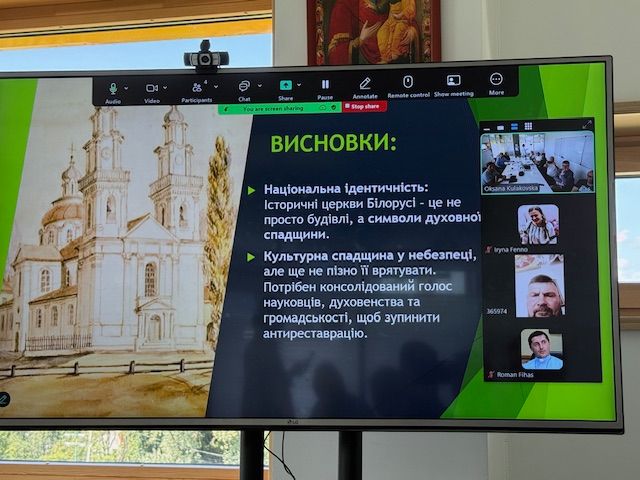
Oleh Tkachenko, a member of the NGO Center for Belarusian Communications, spoke about the “anti-restoration” of sacred architecture in Belarus. The ROC is deliberately destroying the local architectural tradition. Its influence on the religious life of communities also comes through altering the visual environment in which believers live, so that even in physical space, nothing reminds them that Belarusians are distinct from Russians. The process of “anti-restoration” is one of the ways the Moscow Patriarchate’s Belarusian Exarchate consolidates its control.
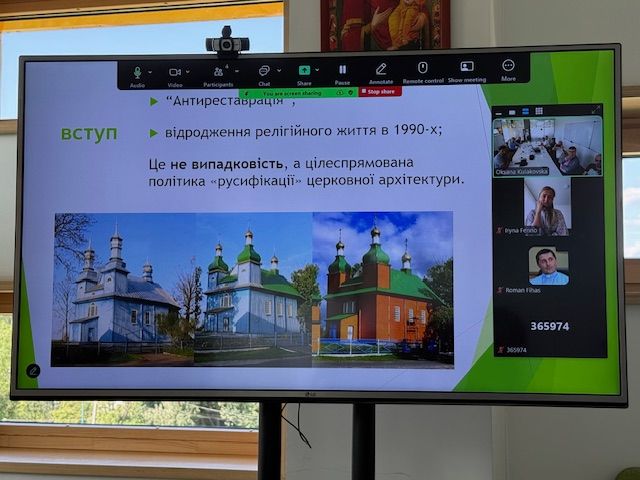
“Anti-restoration is a deliberate policy of Russifying church architecture. It is carried out under the guise of restoring old architectural forms. But in reality, it is not about creating higher quality, but about erasing their originality. European styles were replaced with Synodal ones to create a single space with Muscovy. The practice reached its height in the 1990s. Interestingly, anti-restoration also took place in Ukraine, especially visible in Zakarpattia, where the ROC actively altered the architectural composition of Ukrainian churches.”
The historical backdrop is the Russification of the Belarusian Church after the liquidation of the Union of Brest, from 1586 through the Polotsk Council of 1839. For over 200 years, European religious practice flourished in Belarus. The purpose of anti-restoration is to destroy that legacy — and it has now continued for almost 200 years. Icons, statues of saints, and worship in the Belarusian language all came under repression. Anything that did not fit into the Russian Orthodox canons was destroyed.
After suppressing the Belarusian January Uprising of 1863–64, Mikhail Muravyov launched mass construction of new churches in the Russian canonical style — onion domes and gilding. The same architecture appeared in Ukraine, since our lands were also under Russian rule at the time.
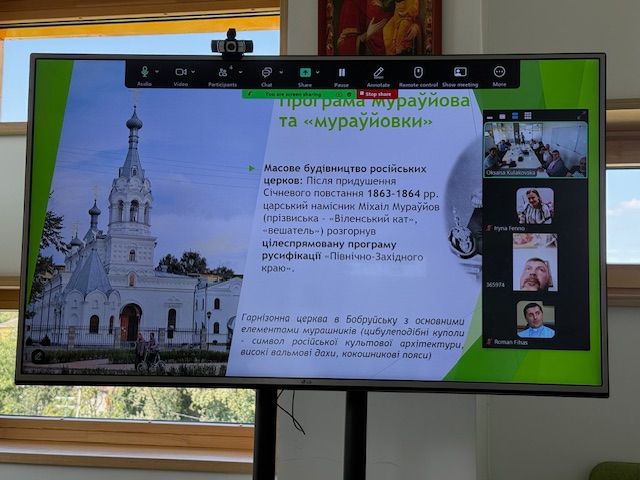
Beyond threatening national self-awareness and identity, anti-restoration also damages historical heritage technically and visually, since the reconstructions are done chaotically and without experts. The process is covered by the slogan of “bringing everything into a single canonical style.” Russians consider anything that is not theirs “wrong” and “non-canonical,” so they impose unification — deepening cultural expansion.
The only confession that now speaks loudly about anti-restoration is the Belarusian Autocephalous Orthodox Church. Petitions have been sent to the Belarusian Ministry of Culture demanding that the process be stopped. But nothing has gone beyond words. In reality, no one can influence the actions of the ROC. Roman Catholics protect their churches thanks to funding from Poland. Greek Catholic churches, however, which have now been taken over by the Belarusian Exarchate of the ROC, are gradually losing their function and can no longer serve as examples of European heritage.
For the record, independent media in Belarus did not exist before 2020. As for outlets operating from abroad, criminal liability has been introduced: it is dangerous to read them, subscribe, or even leave reactions. People simply cannot access independent information. There is even a mandatory subscription to Belarusian state newspapers — if you don’t subscribe, your work contract is not renewed.
Lukashenko’s policy is anti-Western. New generations are often unaware of the history of their own land. On the school exam, out of one hundred questions, only a few concern the period before 1917. All the rest are about the 20th century. The “legal” Church supports this ideology, which is why fewer and fewer people identify as active Orthodox believers.
“People are searching for a new breath of air in the swamp that Russia and Lukashenko’s regime have created in Belarus. Why are people turning away from Orthodoxy? Why are they not as religious as in Ukraine? Because when you go to church, you want to hear relevant, trustworthy things in the sermon. But in Belarus, even priests cannot express their own opinion. If today you say someone was beaten or exiled, tomorrow you will be the next. So people hear nothing relevant — and they don’t want to consume Moscow’s gruel. In Ukraine, it’s different, because in church you can hear something useful for the soul, for growth, for peace. It is the one cultural process where one thing flows from another,” explains Oleksii Frantskevych, head of the Free Belarus Charitable Foundation and the civic union Belarusian Community of Ukraine.
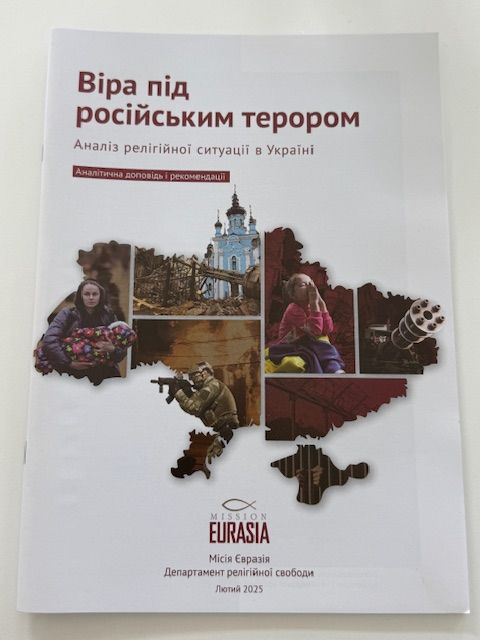
Mykhailo Brytsyn, Director of the Department of Religious Freedom at Mission Eurasia and a presbyter of the Evangelical Christian Church Grace in Melitopol, rightly notes that religion has become a weapon of the Russian World.
“When communist propaganda stopped working, only the Church remained. This is the only thing that can rally different people for war, since neither Russia’s economy nor culture can provide such power. In Belarus, religion becomes a factor of uniting people in service to — and persecution for — the closed regime. Since 2022, this has meant persecution for anti-war positions. The KGB has become an instrument of repression, just like the FSB in the temporarily occupied territories of Ukraine. In occupied Melitopol, it wasn’t priests who came to our community with arguments — it was the FSB with machine guns.”
In Belarus, there are plans to build a “religious center” for representatives of all confessions. But the purpose is not support — it is control. In 2020, six thousand Christians in Belarus signed an open letter to the government demanding an end to violence. Was this politics? No — it was simply a statement consistent with Christian ethics, the ethics of Christ, not the ethics of violence. At the protests, Catholics, Orthodox, and Protestants united. Something touched people’s hearts, and that was not politics, because politics alone does not touch.
The religious situation in Belarus shares many similarities with that in the temporarily occupied territories of Ukraine. The similarities are demands of loyalty to the regime and an outright ban on unregistered religious communities. In 1961, the USSR issued an “instructional letter” that forbade churches from baptizing anyone under 18, taking children to existing Protestant churches, or allowing guest preachers in other churches. Communities that refused these terms were persecuted, but they continued to exist.
In 1991, Ukraine adopted the most democratic law on freedom of conscience in the post-Soviet space. But in Belarus, the “Russian era” continues: repression of unregistered communities, accusations of extremism (meaning: resisting law enforcement, “discrediting” the Republic of Belarus, and disturbing public order).
In both Belarus and the occupied territories of Ukraine, praying in the native language is forbidden, as is praying for Ukrainian soldiers or for peace. Restrictions continue on different churches, along with economic pressure. The law adopted by the Belarusian government in 2024 introduced several new limitations:
• unregistered religious communities lose their legal status,
• criminal liability for activity without registration,
• a ban on any political activity (including joining political parties or holding non-liturgical gatherings in churches),
• state control over all church content — which must not contradict “traditional Belarusian values” or state ideology, effectively legalizing censorship of all religious life.
In addition, only Belarusian citizens may be leaders of religious communities.
“The Church used to be the place where you could open your soul. Now you can’t, because someone will inform. So churches stop fulfilling their function — no wonder people don’t want to attend places that sing in chorus with the regime. When Russians occupied Melitopol, they were surprised by the number of Protestant communities. They see this land as Russian, but it never was. Southern Ukraine has long been home to many nations and denominations that learned to live together, uniting against a common enemy. In 200 years, there was never a conflict over religion in Melitopol. For Russians, this is nonsense.”
Russia wanted to subjugate southern Ukraine. But that is impossible. More than 30 years of freedom, and before that — Makhnovshchyna, the Zaporizhian Sich, the Wild Steppe. In 2014, the Russian flag flew over Melitopol briefly — the city was liberated. In 2022, people bravely came out to protest against the occupiers. You can occupy the land, but not the will of the people.
“I feel deep sorrow that people in Belarus have to go through this. Those who fled say it is impossible to live there. Those who remain have gotten used to it. Why? First the Soviet Union, then Lukashenka’s rule. Now, even if Belarusians gained freedom, they would not go out to protest corruption, domestic violence, or for culture. Because ‘that’s all politics.’ We must share what is happening. We need unity of religious communities and civic organizations. Only education can help us in this,” emphasizes Mykhailo Brytsyn.
Iryna Fenno, visiting researcher at the Faculty of Catholic Theology at Ludwig Maximilian University in Munich, adds that there is clearly a demand for an alternative faith. This became evident in 2020, when previously silent communities, religious leaders, and believers began to express disagreement with what was happening. The 2024 law was the regime’s final answer to those protests.
Both in Belarus and in the temporarily occupied territories of Ukraine, where the re-registration of religious communities began back in 2014, a monolithic religious landscape is being formed — one that must be absolutely loyal to state ideology and the political regime, since any expression of dissent is punished. Since 2020, seventy-four clergy and pastors have faced various forms of pressure, persecution, and even violence. That is only the officially recorded figure; in reality, the number is much higher. In Europe, however, there is little awareness of the situation in Belarus. By contrast, the story of the “persecution” of the Moscow Patriarchate in Ukraine is very well covered in the media — thanks to Russia’s deliberate efforts.
“Why does the totalitarian regime in Belarus or Russia succeed in pressuring religious organizations, unlike in Ukraine? Because religious communities there do not really seek common ground with one another. In Ukraine, interconfessional conflicts arose, but within the healthy part of society, an understanding developed that unity had to be sought. Only the Moscow Patriarchate always stayed aloof from ecumenical processes. I always recall how Blessed Lubomyr issued a message saying that breaking traffic rules is a sin. That is an example of how the Church’s mission must extend into every area of life. But in Belarus, we see no ecumenical cooperation. Of course, it is a totalitarian state, and the regime’s power is immense. Yet when religious actors themselves abandon subjectivity in relations with one another, the state finds it far easier to impose control,” notes Anatolii Babynsky.
Mykhailo Brytsyn adds that Ukrainian society has matured. If real leaders emerge in Belarus, then even there healthy movements could arise that would influence the Church, education, and other areas of public life. Oleh Tkachenko observes that the regime is precisely afraid of religious leaders becoming voices of truth, public leaders. For instance, priests of the Greek Catholic Church have been banned from being active on social media: they cannot run pages, explain or interpret issues, or even express personal opinions.
“The situation in Belarus now is the same as in the temporarily occupied territories of Ukraine. Yet there are believers who, despite the risks, hold services out of sight — like the first Christians. In past years, something similar already happened: services were held in homes, with constant fear that neighbors might report them. Now they hide altogether, making sure nothing can be seen or heard — not the singing, not the incense. And this is not the Middle Ages — this is the center of 21st-century Europe. But we must not stop, and we must bring the truth about Belarus and its Church to the world. People need to know that an independent Belarusian Church exists at all. Then competition becomes possible. We are in a war for human souls, a war against evil. People are brainwashed — including by the Church. This has become especially acute during Russia’s war against Ukraine. What a Russian bayonet does not accomplish, a Russian bureaucrat, teacher, or priest will. Our task is to resist this,” says Fr. Vyachaslau Kuchuk, priest of St. Cyril of Turov Church (BAOC) in Toronto.
Russians will never recognize the autocephaly of either the Ukrainian or the Belarusian Orthodox Churches. In their view, we are all one nation of “Russkiye”, Russians, and should have only one local Church. For the same reason, according to Fr. Yevhen Orda, Belarusians will never be allowed to celebrate liturgy in their own language. Russians understand very well that in Ukraine language became a step toward awakening national consciousness.
“No matter how much they try to destroy us and fill our heads with ideology, we have the call of the homeland, love for it, faith, and God — that is the remedy that awakens us. It was hard to believe we would ever receive the Tomos. But it happened because what is impossible for people is possible for God. In Belarus, too, there are chances for autocephaly. However, for those who remain in the country, it is difficult to analyze information, since it comes only from one source. That is why we must work from the outside. Processes of distancing from the Moscow Patriarchate are also underway in Estonia, Latvia, Lithuania, and Kazakhstan. And with Ukraine’s victory, Belarus will also win. The ROC has carried out expansion for centuries. We can resist with education: explaining what is happening, especially to Belarusians who remain living under the regime,” he adds.
To speak fully about the autocephaly of the Belarusian Orthodox Church, one must first wait for the de-occupation of the country. For now, such processes depend entirely on the will of the political leadership. Every nation has its own path to autocephaly; there is no universal protocol for receiving it. But there are steps that can help Belarusians move closer to independence.
Belarus must reach the stage of consciously opposing Russian Orthodoxy and refining its own distinct identity. For example, this approach worked in Ukraine. The autocephalous movement had a history spanning more than a century, was widespread, and survived in emigration. The UGCC also contributed to the development of religious consciousness by being a multifaceted structure that encompassed both religious, social, and national aspects (a characteristic that Belarusians also require). There, theses were voiced about the fundamental difference between Ukrainian and Russian Orthodoxy. For now, Belarus must focus on developing its own self-awareness, self-identification, and establishing independent institutions and organizations — not only abroad but also within the country. Otherwise, separation from the Russian World will never happen.
##DONATE_TEXT_BLOCK##