
John L. Allen, Jr. – an Example for Journalists


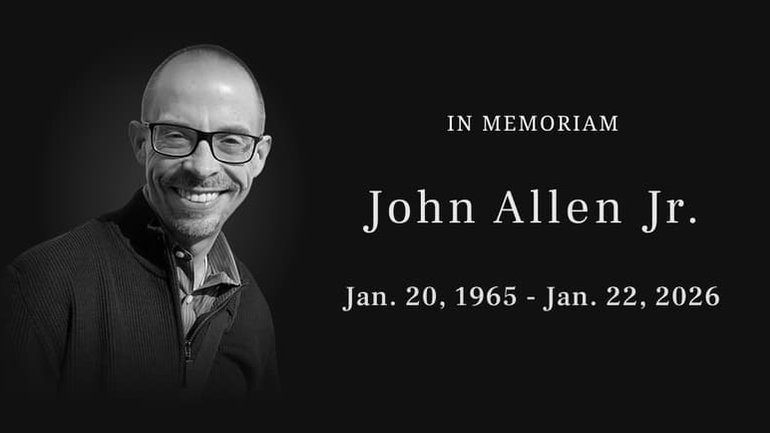
The author of eleven books, Allen was mourned as an energetic and inquisitive reporter who “would talk to anyone,” as well as a fair and balanced analyst of Church affairs. His columns reflected an intelligent curiosity not only about the intricacies of Vatican politics, but also about the mysteries of Italian Catholic folk culture and the arcana of Church history, which he explored with wit and grace. His writing was lively, humorous, and perceptive. Allen did not limit himself to the church press, appearing in the New York Times and on National Public Radio. He avoided falling into the “liberal Catholic” or “conservative Catholic” camp. He also exhibited intellectual humility: when his biography of then-Cardinal Ratzinger was criticized for bias, he admitted his error, and went on to write another, more balanced biography of the man who by then was Pope Benedict XVI. It was a sign of the breadth and depth of both his convictions and his connections that upon hearing of his passing, the well-known conservative thinker Rod Dreher, author of The Benedict Option and a Catholic convert who is now Eastern Orthodox, posted a particularly warm and thoughtful appreciation on X. John Allen was also remembered as a sociable bon vivant with a keen appreciation of the pleasures of the table.
He was also a friend of the Ukrainian Greek-Catholic Church.
This did not happen by chance. Ukraine and her Churches have often been neglected – or worse, maligned – by the press, and Ukraine’s reputation in Rome has been mixed. The situation improved in the late 1980s, when a press office was established at the Rome offices of Major Archbishop Cardinal Myroslav Ivan Lubachivsky, just as his Church was emerging from the catacombs. But while Ukrainian independence in 1991 paralleled the re-establishment and legalization of the UGCC, the increasing anti-Ukrainian rhetoric of Russian propaganda in the Putin era after 2000 posed a new threat.
At this time, the Kansas-born Allen was the US-based National Catholic Reporter’s Vatican correspondent. In March of 2012 the president of the Ukrainian Patriarchal Society in the USA, Roma Hayda, invited Allen to visit Lviv as a guest of the Society. Allen spent three days in Lviv in October of that year, interviewing Ukrainian Catholic University rector Bishop Borys Gudziak and speaking at a conference organized by the Ukrainian Patriarchal Society on October 20. The event was not particularly well attended; one University official reportedly declined to participate because it was taking place on a Saturday.
Two years later, in 2014, John Allen left the National Catholic Reporter and, in partnership with the Boston Globe, founded the news outlet Crux. He also served as senior Vatican analyst for CNN. Crux became a prime Catholic news source: after his accession to the papal throne on May 8, 2025, Pope Leo XIV granted its correspondent Elise Ann Allen, John Allen’s wife, his first exclusive interview. During those years, John Allen repeatedly wrote and spoke about Ukraine. Among his contributions to Crux and Crux Now were “Is the Pope Going to Ukraine?”, “Cardinal Survives Attack in Ukraine,” “Pope’s Secret Weapon for Peace,” and “Pope Rejects Ukraine’s Orthodox Ban.”
Although Ukraine will no longer benefit from John Allen’s reporting, Ukrainian journalists can learn valuable lessons from him. In anticipation of his planned lecture at the Ukrainian Catholic University in 2012, Allen prepared a memorandum on “Reporting on Sensitive and Controversial Topics: Balancing Faithfulness and Objectivity.” To begin, he noted that he did not see himself as a “Catholic journalist,” but “rather as a journalist who happens to be Catholic.” It was not, he believed, the role of reporters to evangelize. Rather, he felt called to practice “fairness, balance, accuracy, and telling the whole story.” At the same time, he pointed out the problem of incomprehension between the secular media and the Catholic Church. On one side, the secular media did not take religion seriously, catered to the biases of select groups of readers, contented themselves with timely but superficial reporting, and tended to fall back on a deep skepticism towards institutions. On the other side the Church, which “thinks in centuries,” was slow to respond to events, failed to incorporate communications into its decision-making process, was too quick to mistake journalists’ “religious illiteracy” for hostility, and had become so politicized and divided as to obscure its real stance on a given issue. An example of this mutual incomprehension between the Church and the secular media was the latter’s reporting on clerical sexual abuse, which was marred by the absence of comparative context.
What was Allen’s remedy for this flawed relationship? First, journalists are obligated to “get the story right.” For the Church, “some degree of detachment from concern for its ‘brand’ is spiritually healthy.” Nevertheless, it cannot conduct a successful “New Evangelization” unless it takes steps “to improve its public profile without betraying itself.” In conclusion, Allen suggests that “one key quality the Church needs in its relationship with the media is a sense of humor, meaning an ability to laugh at itself and its foibles.”
Ukrainian journalists – and the Ukrainian Churches — would do well to take John Allen’s advice.
*) Christopher White, “Remembering former NCR Rome correspondent, Crux founder John L. Allen, Jr.,” NCR online, January 22, 2026; Colleen Dulle, “Vatican expert John Allen shaped a generation of Catholic reporters,” America online, January 22, 2026; “John Allen, Jr.—author and longtime Vatican rerporter, dies at 61,” EWTN News online, January 22, 2026; Tod Worner, “John Allen, our friend at the Vatican,” First Things online, January 23, 2026.