
'War lays bare the truth of human nature': Norwegian bishop reflects on his experiences in Ukraine


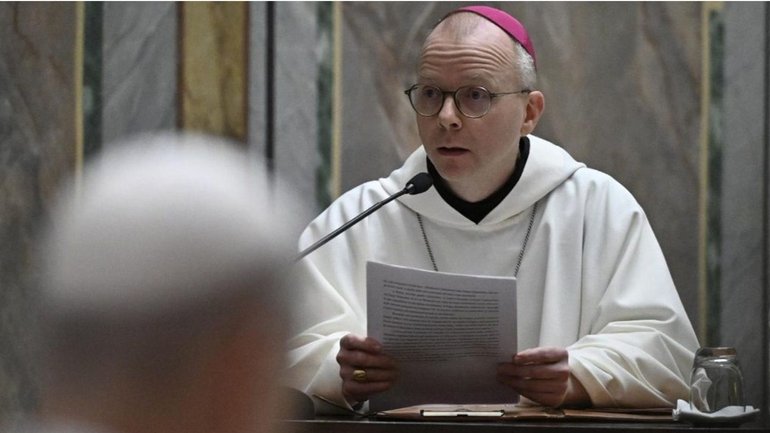
This was reported by the UGCC Department for Information.
Bishop Varden recalls a nighttime train journey to Kyiv in May 2023, during which the city was under missile attack. This experience serves as a starting point for his deeper reflections on the nature of war.
He describes war as a manifestation of impersonal force that can turn a person into a “thing.” According to Bishop Varden, the experiences in Ukraine clearly demonstrate how violence dehumanizes individuals, reducing life and death to mere statistics. He reflects, “Force turns people into things and lands into territories. Violence crushes those it touches, becoming alien to both those who inflict it and those who suffer from it.”
Bishop Varden highlights the stark contrast between the brutal reality of war in Ukraine and Russia’s official rhetoric. On the very day he arrived in Kyiv, a military parade was taking place in Moscow. He remarks, “If there ever was a demonstration of instrumentalized power, this was it.”
He notes that this display of force was accompanied by rhetoric about “freedom” and “liberation.” He was struck by the Russian president's description of the military show as a mobilization for the sake of freedom.
Commenting on this, the bishop expresses concern about a troubling trend in contemporary discourse — the use of the concept of “freedom” as a rhetorical tool to justify aggression. He points out that wars can be waged when an invasion of a sovereign, non-belligerent neighboring state is framed as a campaign for “freedom.” In his view, this distorts the very meaning of freedom and misleads society.
In contrast, Ukraine's experience reveals a fundamentally different understanding of freedom — not as the rhetoric of power, but as the reality of suffering, dignity, and resistance. Reflecting on his visits to Irpin and Bucha, as well as his meetings with people who have lost loved ones, Bishop Varden emphasizes that war reveals profound truths about humanity — its vulnerability and its capacity for courage and solidarity.
He stresses that the Christian understanding of freedom is not linked to violence or domination. “Christian freedom does not consist of conquering the world by force, but in loving it with a crucified love — so generous that we are willing to give our lives for it, so that the world may be set free in Christ.”
Ultimately, in Bishop Varden’s sermon, Ukraine’s experience serves not only as a testament to the tragedy of war but also as a moral challenge for contemporary Europe. He poses the question: Are we substituting freedom with force, ideology, or political interests?
The answer offered by the Christian tradition is radical: true freedom is not something that can be conquered; it is a gift given and received, with its highest expression in love, capable of enduring even in the face of war.