
Bishop Maksym Ryabukha: “War Cannot Put Human Life on Pause”


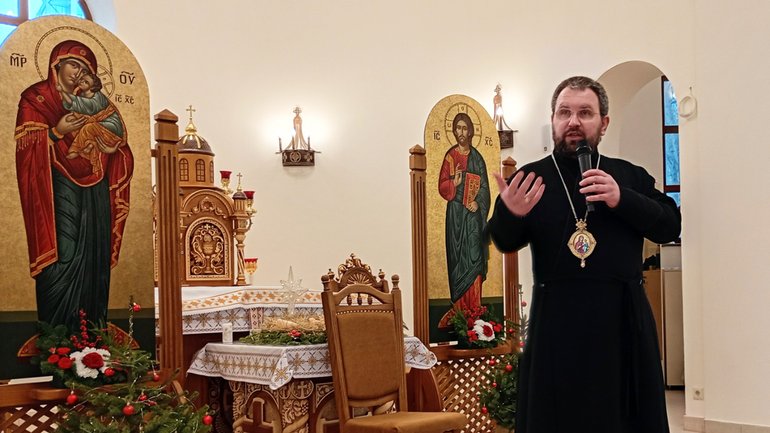
— Your Grace, what role did joining the Salesians play in your personal life and vocation?
— I grew up at the Salesian parish of the Protection of the Most Holy Mother of God in Lviv, and those school years were extraordinarily important for me. Through the ministry of the Salesian Sisters and Salesian Fathers, I had the opportunity to discover the spiritual dimension of human life while passing through various stages of formation: from participant in the Oratory, youth groups, animator courses, and catechesis, to animator, the closest helper in ministry to children and young people.
My encounter with the Salesian spirit began in childhood, around 11 or 12 years old. Those adolescent years revealed much to me: how the charism of Saint John Bosco works and inspires, how potential and talents unfold, how one's inner world is formed. I wanted to share all of this with my friends.
At the same time, I kept asking myself: who do I want to be in life? The Salesians' example captivated me. I often thought I would like to be like Father Vasyl, Sister Maria, and others who served at our parish. Yet I was also aware of my lively, restless nature, and at the time, I could not imagine becoming a Salesian. I was planning to enroll in an agricultural university. But Divine Providence led me to decide to go to the pastor and say I wanted to try this path. To my surprise, I was accepted into the pre-novitiate in Obroshyne (a village near Lviv — ed.), and that was how my Salesian life began.
That choice gave me a clear direction: studies in Italy, pastoral practice in Odesa at the Don Bosco Youth Center, and in Obroshyne. All the years of formation confirmed me in my primary desire — to follow God, to follow Christ. The example of Saint John Bosco became my guiding light. That is why this period became a great treasure for me.
My openness was also important: I entered the religious house straight from school and, like a sponge, absorbed everything I heard and saw, taking it all to heart. That experience became the foundation of my subsequent priestly ministry — a treasure I constantly return to and draw from.

— Does the Salesian charism help you in your episcopal ministry today?
— When I think today about the Salesian charism, I recall the final days before my episcopal ordination. Back then, young people and our animators in Kyiv would come to me with heavy hearts. They knew my love for children and youth and would say sympathetically: “Father, can you imagine — you are going somewhere where there are no young people.” Thinking about it, I felt sadness, because I understood that my life would no longer be as it had been. But when I became bishop, I saw: God had taken nothing away.
I found myself in an environment with many children and young people. Today, in animator courses alone, around 60 people have consciously chosen to be leaders in their parishes. That is a great resource. In addition, we have many children in catechetical schools. When I visit parishes in Donetsk, Luhansk, Zaporizhzhia, and Dnipropetrovsk oblasts, I see children and young people in every one of them. For me, this is a sign of hope and, at the same time, a source from which I draw strength. Seeing children is always an inspiration and a reminder of our responsibility for those who are already a sign of God's care and love, and an image of the future being shaped today.
— In 2024, you became the Exarch of Donetsk. In one of your interviews, you said: “Do not lose hope amid the disaster of war.” Are you managing to do that? How is the exarchate living today?
— The year 2024 — specifically, the end of November — became a kind of turning point in my life. As auxiliary bishop of the Donetsk Exarchate, I had enjoyed the enormous trust of my predecessor, Bishop Stepan, in my pastoral ministry; I traveled extensively, visiting parishes and priests. That gave me the opportunity to engage with the wider open world while also assisting Bishop Stepan in his ministry. The moment of my appointment as Exarch of Donetsk changed everything that had been happening in my life.
Today, my work and ministry carry greater responsibility — for priests, monastics, seminarians, our parishioners, and the faithful. Although the boundaries of the Donetsk Exarchate are clearly defined by four oblasts, many people originally from the exarchate now live in other parts of Ukraine as well. That bond of unity calls me to give everyone a sense of wholeness and belonging to a spiritual family: both those who are today on the territory of the exarchate, and those who, because of the circumstances of war, had to leave their homes and carry an enormous longing for them.

Yet every time I reflect on this experience of pain, I also reflect on the fact that Christ himself passed through all those sufferings and trials — even as a very small child, during the persecution of the Holy Family, when he had to flee to Egypt seeking refuge from the slaughter of the innocents. And then there were the sufferings of Christ during his Way of the Cross — the torture, the scourging, his death. That experience of pain lasted a very specific period of time, and then it all ended — ended not simply in death, but in Resurrection. And I understand that this experience of pain must ultimately call both me and everyone else to contemplate the Resurrection, which is the greatest sign of hope. Not losing hope is an inner imperative by which I live and which I draw from life in the Holy Sacraments. I also try to share this inner spiritual conviction: in God we truly have the greatest sign of hope — evil can never be greater than God and God's love.
— What challenges does the exarchate face today? How does the Church respond to them?
— The challenges facing the Donetsk Exarchate are, on one hand, stable — owing to the duration of the war — and on the other, constantly changing, because war brings new experiences that were not there before. First and foremost, it is the challenge of loss and pain. As Christ's Church, we are called to be beside people who suffer and endure profound injustice in their lives. This means concrete social ministry: support for the poor, internally displaced persons, and people living in fear of constant shelling, amid the instability caused by the lack of electricity, heat, water, and other basic necessities. These circumstances shape the directions of our ministry.
War cannot put human life on pause. It destroys homes and forces people to leave everything behind, to rebuild their lives from scratch. There are ever more such people. Among them are our own priests, monks, and nuns who, together with their communities, are experiencing the loss of home and are compelled to seek new places for life and ministry.
— What is the mood of your faithful today? In your view, are they losing faith during the war?
— When I think today about the mood of the faithful, I understand that it is very sensitive to everything that happens each day. At the same time, I see that the presence of priests and monastics gives people more warmth, peace, and hope. Where the Church is alive, people find the inner strength not to break, feeling God's presence and inner resilience. Spiritual life not only supports but also inspires people to be a support for others.
 Today, there are more people in our churches — those who seek God, deeper meaning, support, and living community. In the company of others, a person finds answers, strength, consolation, and even friends, which helps move forward. Those who have the courage to seek God not just preserve their faith — they deepen it in daily life. Many people come to the Church because someone brought them, showed them a place where one can find calm, warmth, understanding, and that silence in which one can bring and surrender one's pain. I believe that communication, interaction, and mutual support are great resources that help people not to despair or be disappointed, but, on the contrary, to keep walking forward.
— Saint John Bosco said that education is a matter of the heart. There is a school in Zaporizhzhia run by the Salesians. Tell us about the work of this school and why you place such emphasis on Catholic schooling.
— Saint John Bosco said that even in the most unruly child, one can find a string of goodness and make the most melodious instrument play in their heart. For us, establishing a Catholic school became one of our priorities — something we prayed for and sought like-minded people to support. The opening of the Don Bosco Catholic School in Zaporizhzhia became for us a sign of Divine Providence. Today, about 30 children study here, and this is already a witness to the fact that God does not abandon us.
Catholic education opens a wider horizon for children — a sense of the world as a global community rather than a hostile environment. It forms deep moral and spiritual values and helps develop the person in the light of God's design. For God, the Creator, calls everyone to be a co-participant in his creative mission. Children create shared events and celebrations, and they grow — and they carry this experience into their families, sharing it with their parents. In this way, it is not only the child who grows, but the family and the wider environment in which they live.

— Your Grace, we are in the season of Great Lent (the interview was recorded during Lent — ed.). Do you have, from your own experience, any particular practices that help you personally live through this time?
— It is a time when you have the opportunity to stop and look at your life from the outside: to understand where you are and where you are headed. At the same time, it is an occasion to pause in contemplation of Christ and ask yourself simple but honest questions: Am I like you? Do I live by the values to which you call me? Do I have the courage to be who you envisioned me to be from the beginning? Great Lent is a time of inner conversion and rediscovery of oneself. A time when we rediscover how precious it is to be human, rather than merely to exist. Christ, loving us, never stays silent — he always speaks to our hearts.
It is also a time of prayer. And while there are many good recommendations, I wish only to emphasize prayer's simple yet profound essence: speaking with God. Sharing what you live with — your experiences, fears, and dreams. Putting into words before him everything that is in your heart. But prayer is always a dialogue. It is not only speaking, but also listening. Listening to God — in the words of prayers, in their content, which reveals to us the truth about him and about ourselves, about our values and the meaning of life. Listening to him in Sacred Scripture, where we find answers to the deepest questions.
Prayer is also an encounter with Christ in the Holy Sacraments, particularly in Confession, where we give him everything that distances us from him. And at the same time, in the Most Holy Eucharist, we experience God's presence, his closeness, and his joy in our lives. It is precisely this experience of God's love and closeness that fills us with peace, joy, and the inspiration to keep living.
##DONATE_TEXT_BLOCK##