
Ecumenical Patriarch on new technologies and AI: No prudent person can deny the benefits of science and technology


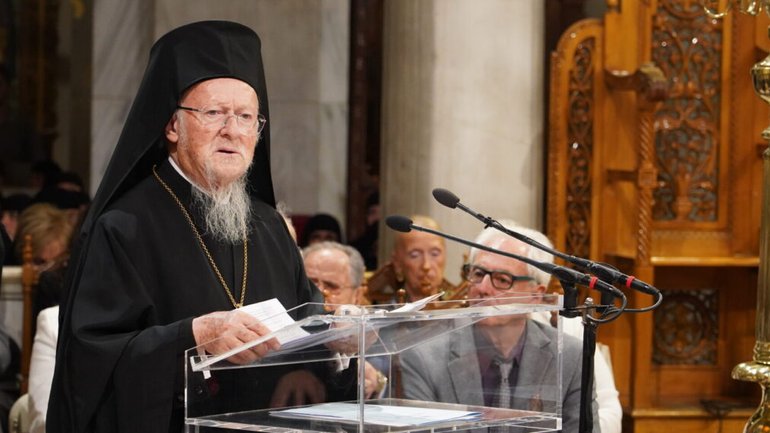
The Ecumenical Patriarch Bartholomew honored the event with his presence, delivering the opening address and formally declaring the start of the conference proceedings, according to Orthodox Times.
In reflecting on the interaction between theology and culture, he referenced the First Ecumenical Council held in Nicaea.
“The Fathers of the First Ecumenical Council of Nicaea, whose 1700th anniversary the Church honors this year, despite the fact that the teaching of Arius represented ‘a sharp Hellenization of Christianity,’ introduced the philosophical terms ousia and homoousios into the Creed without fear of trapping doctrine in Hellenistic mental schemes. Philosophical terminology here functioned as a suitable means of expressing ecclesial experience.”
Patriarch Bartholomew underlined that the task of theology is always to proclaim the Gospel faithfully within the cultural moment: “In meeting each culture, the aim of theology is ‘to transmit the message of the Gospel intact, entire, unadulterated, and to present it with the finest means of communication that a cultural environment can provide.’ The use of the possibilities offered by culture is an indication of the vitality and dynamism of theology. The defensive stance of the Orthodox Church toward culture — as if all the developments of the age were directed against her — does not correspond to the spirit of Orthodoxy nor to the mission of the Church in the world. A closed, sullen, and disembodied Orthodoxy is a lamp ‘under the bushel.’”
Turning to the theme of the conference, he stressed that today the Church faces unprecedented challenges shaped by rapid technological developments: “Never before in history has humanity experienced, in so short a time, so many radical upheavals in the way of life of individuals and societies as in our age. The absolute dominance of technology, the ‘technopoly,’ presses heavily upon other forms of culture, redefines politics, ethics, religion, education, and art, and decisively influences our social relations, private life, and psyche.”
Patriarch Bartholomew paid particular attention to the topic of artificial intelligence.
“In recent years, we have witnessed the spread and reach of ‘artificial intelligence,’ considered the pinnacle of technological progress. Its applications extend into all areas of human life. Some even claim we must now speak of a period ‘before artificial intelligence’ and ‘after it’ in the course of civilization.”
While acknowledging the benefits of science, the Patriarch also highlighted its limits: “No prudent person can deny the benefits of science and technology. Yet it is indisputable that science cannot provide answers and solutions to the great existential and social problems that afflict humanity — violence, injustice, religious fundamentalism, the deadlocks of human relationships, and above all, the ‘last enemy,’ death. These are addressed only by other powers, with the first being religious faith.”
He warned against fundamentalism, calling it a distortion of faith: “Religious fundamentalism, born of fear, insecurity, and the inability to creatively address rapid change, has nothing to do with the authentic experience of faith. It distorts the true expression of religious belief and threatens peace and cooperation among peoples.”
The Patriarch urged theology to engage technology constructively, not as an enemy but as a dialogue partner: “Faith and science do not meet as adversaries, but as collaborators and partners in the service of humanity. The view of an inevitable conflict between faith and science arises from a mistaken understanding of the essence and purpose of these two great spiritual powers.”