
Pokrova the Warrior and the Russian Spirit


“Throughout his life, Grand Prince Andrei fought against enmity and disunity in his land. He firmly believed that the Intercession of the Mother of God would shield Rus’,” — wrote last year on the official website of the Holy Intercession Holosiivo Hermitage of the UOC-MP in Kyiv on the occasion of the Feast of the Intercession of the Mother of God. Grand Prince Andrei refers to the poor fellow from Zalessye, the so-called “Bogolyubsky,” who in 1169 attacked Kyiv, plundering and ravaging it just as the hordes had done. Yet it is precisely he whom the Russian Orthodox Church names the founder of the Feast of the Intercession. “It was our country, Holy Rus’, that received from the ancient hands of the thousand-year-old Byzantine Empire the torch of Orthodoxy and carried it through the ages, naming its capital Moscow the Third Rome,” — the monastery’s website praises the aggressor country in the context of the Feast of the Intercession. Yes, indeed: “our country” in 2024 for the inhabitants of the Kyiv “monastery” is the one whose capital is Moscow. Even though the Church to which it belongs insists that the word “Ukrainian” remain in its name. So what are this church’s ideas about the Feast of the Intercession? Let’s take a closer look!
The “Vision” of Bogolyubsky
According to Russian ideologists, the Feast of the Intercession is uniquely Russian and is found nowhere else in the world. It was supposedly established by Vladimir-Suzdal Prince Andrei Bogolyubsky, son of Yuri Dolgoruky, the founder of Moscow, and grandson of Grand Prince Volodymyr Monomakh of Kyiv. His court bishop, they claim, introduced this feast without the permission of the Metropolitan of Kyiv. In doing so, he effectively signaled the withdrawal of Andrei’s principality from the authority of the capital of Rus’. The “God-loving” prince allegedly instituted the feast because he considered his heavenly patron to be Andrei the Fool-for-Christ, to whom the Mother of God appeared in a vision in the Blachernae Church in Constantinople.
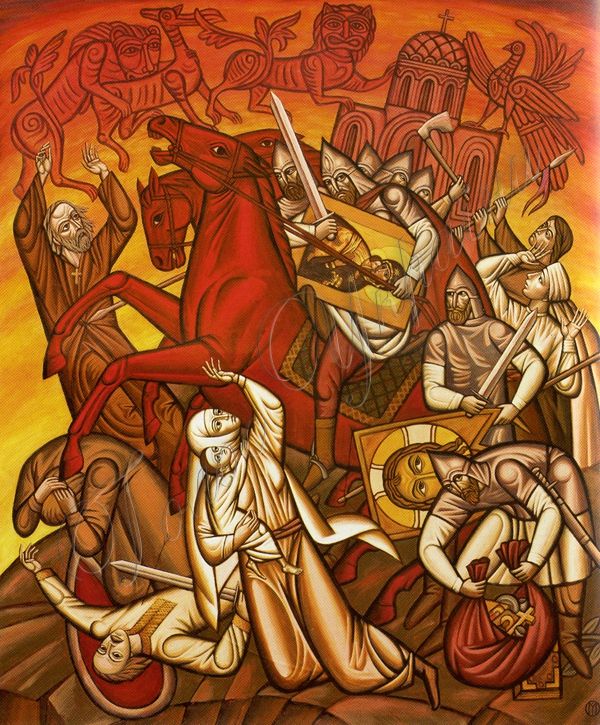
However, scholars suggest that the Feast of the Intercession was actually spread earlier by the young man’s grandfather, the wise and moderate Volodymyr Monomakh. He is the author of a prayer recorded in the chronicles, in which the Intercession of the Mother of God is mentioned several times: “O my hope and Intercession, do not forsake me, O Blessed One! For having you as my helper in sorrow, in pain, and from all evils, I glorify you, O most praised!” He also built churches in the Kyivan state in honor of the Mother of God.
A brilliant hagiologist — a scholar of saints’ lives — Archbishop Serhiy (Spassky) of Vladimir, after studying a pile of documents, concluded in the 1890s that the feast had been introduced in Kyiv at the turn of the 11th and 12th centuries. At the same time, other ancient Rus’ feasts were also established in Kyiv, all of which are listed in the Prologue — a sort of calendar of church events. The Feast of the Intercession is always mentioned alongside these Kyivan feasts.
The “Galician Pokrova”
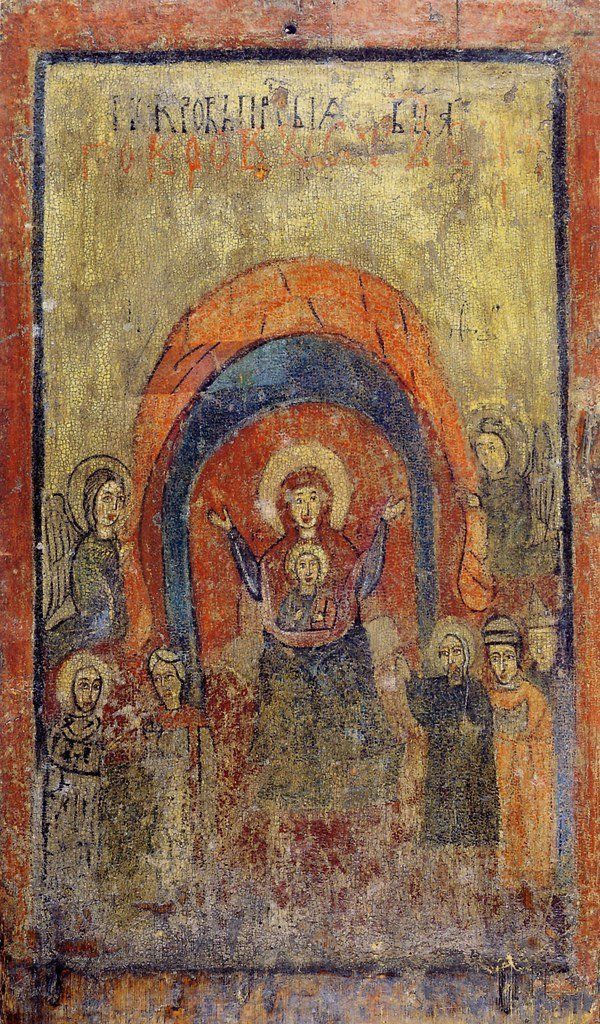
The authenticity of the ancient Kyivan Feast of the Intercession and the continuity of its tradition from Byzantium may also be testified to by an icon from Galicia, known as the “Galician Pokrova.” It was brought to Kyiv by art historian and ethnographer Danylo Shcherbakivsky during an expedition in 1914. Today, it is kept at the National Art Museum of Ukraine. After examining it, Shcherbakivsky dated it to the 14th century. A thorough study of the icon was carried out in Leningrad by art historian and restorer Mykola Pertsev, who, based on specific features, determined its creation to be “pre-Mongol.” Later, the Hermitage conducted a paleographic analysis, which confirmed that it was created no later than the first half of the 13th century. Ukrainian art historian Liudmyla Miliayeva noted that the icon from Galicia is “close to the Marian cult of the Blachernae church.” Scholars have assumed it to be either an original or a copy of an image created in Byzantium or in Kyiv. It is possible that it was taken from Kyiv to Galicia in an attempt to save it from the Mongol occupation. Finally, the most precise radiocarbon analysis established its creation date as the second half of the 11th century.
Mother of Mercy
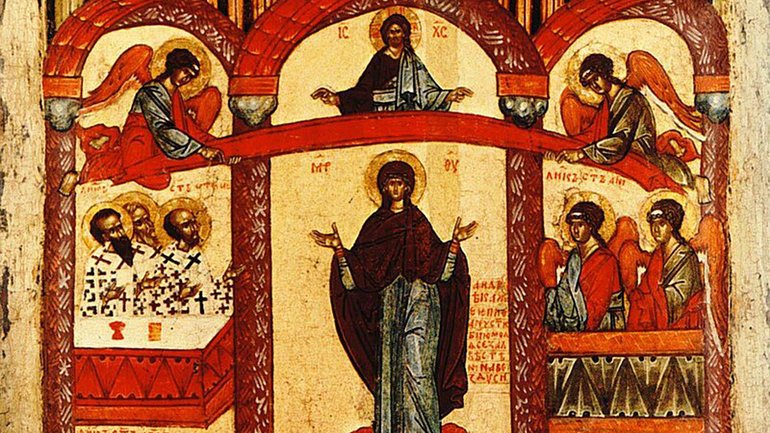
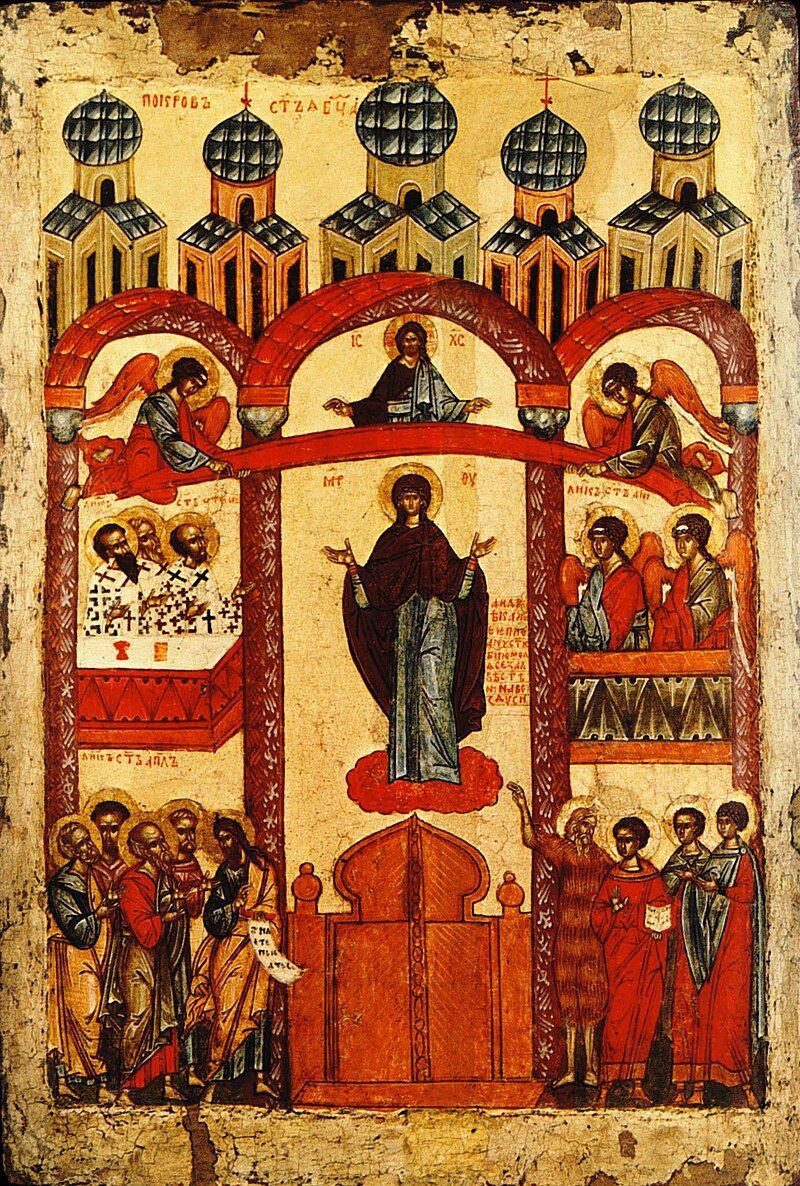
In the era of the post-Mongol revival, the Ukrainian iconography of the Intercession (Pokrova) combined two traditions: Eastern and Western. In the Eastern, Orthodox tradition, the icon is three-tiered and depicts the miracle of Blachernae, seen by Andrew the Fool-for-Christ. In the upper tier, the Mother of God is depicted with angels, spreading her omophorion to cover those below. Among the people in the church is Roman the Melodist, with a scroll — supposedly the author of the Akathist Hymn to the Mother of God. His feast is celebrated by the Greeks on October 1. It is with his story that the Greek Marian feast is associated, which also influenced the early Ukrainian tradition.
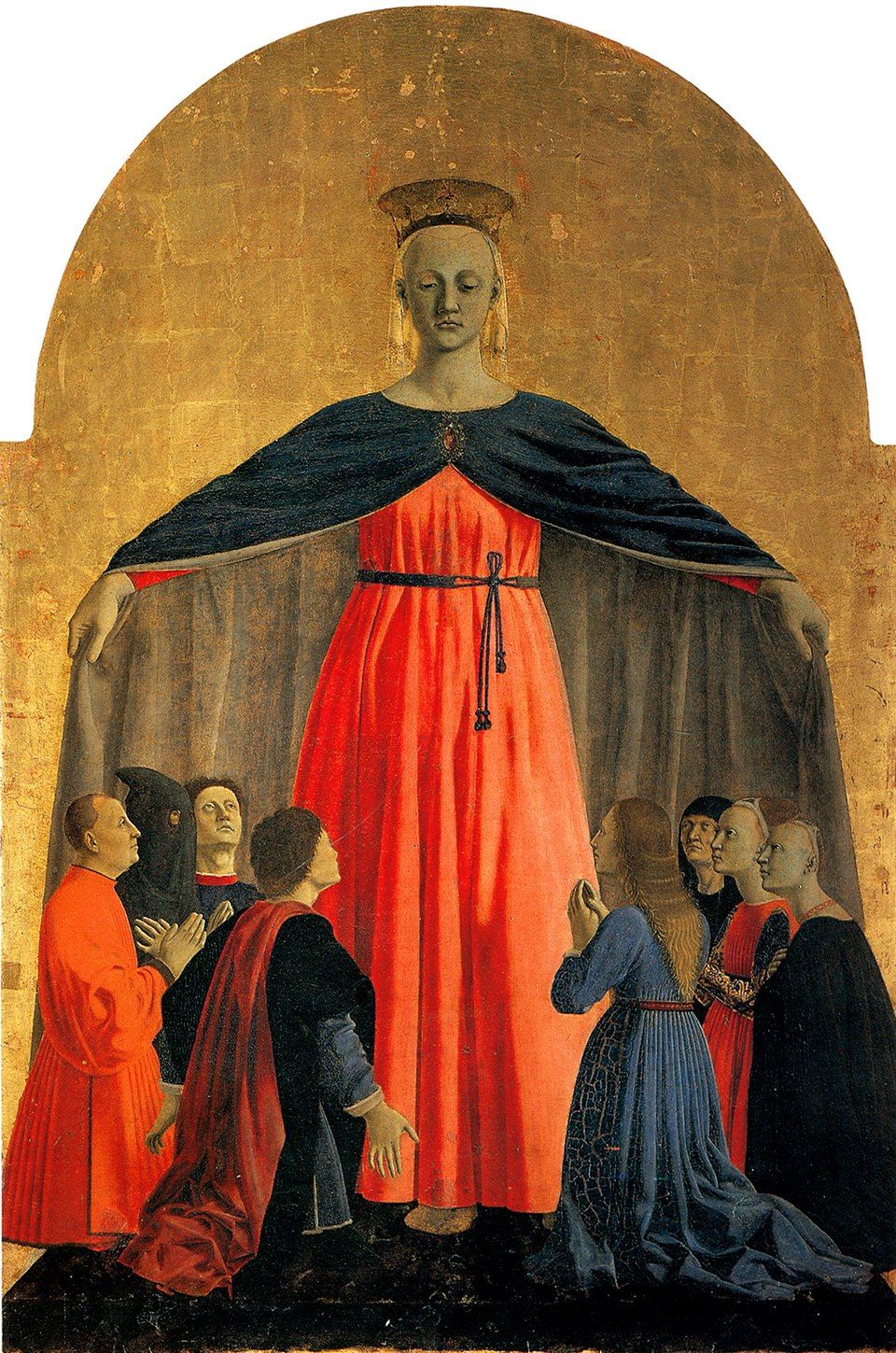
In the Western tradition, the Virgin Mary stands on earth, surrounded by people at her side. She covers them with her cloak or mantle — the maphorion. This type of icon spread from Italy across Europe in the 15th century, including into Ukrainian lands. It is called the “Mother of Mercy.” Iconographers created such images for various social groups, including artisan guilds and merchant associations.
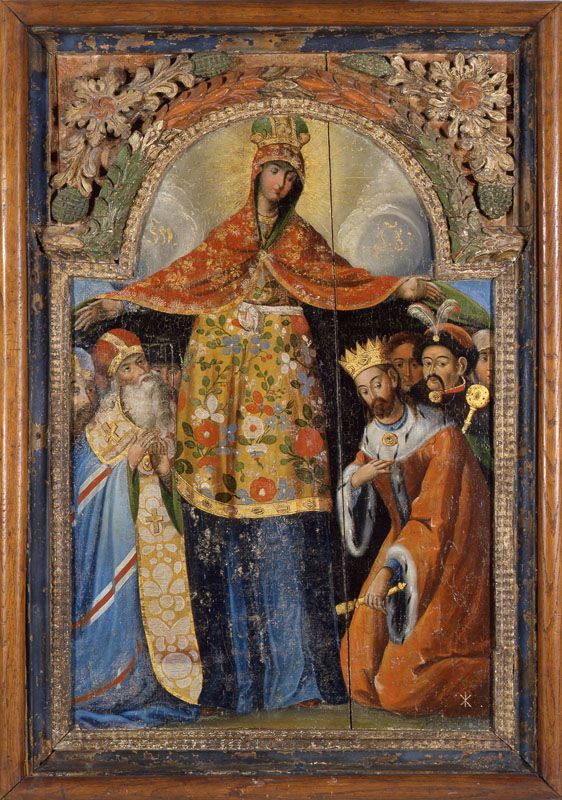
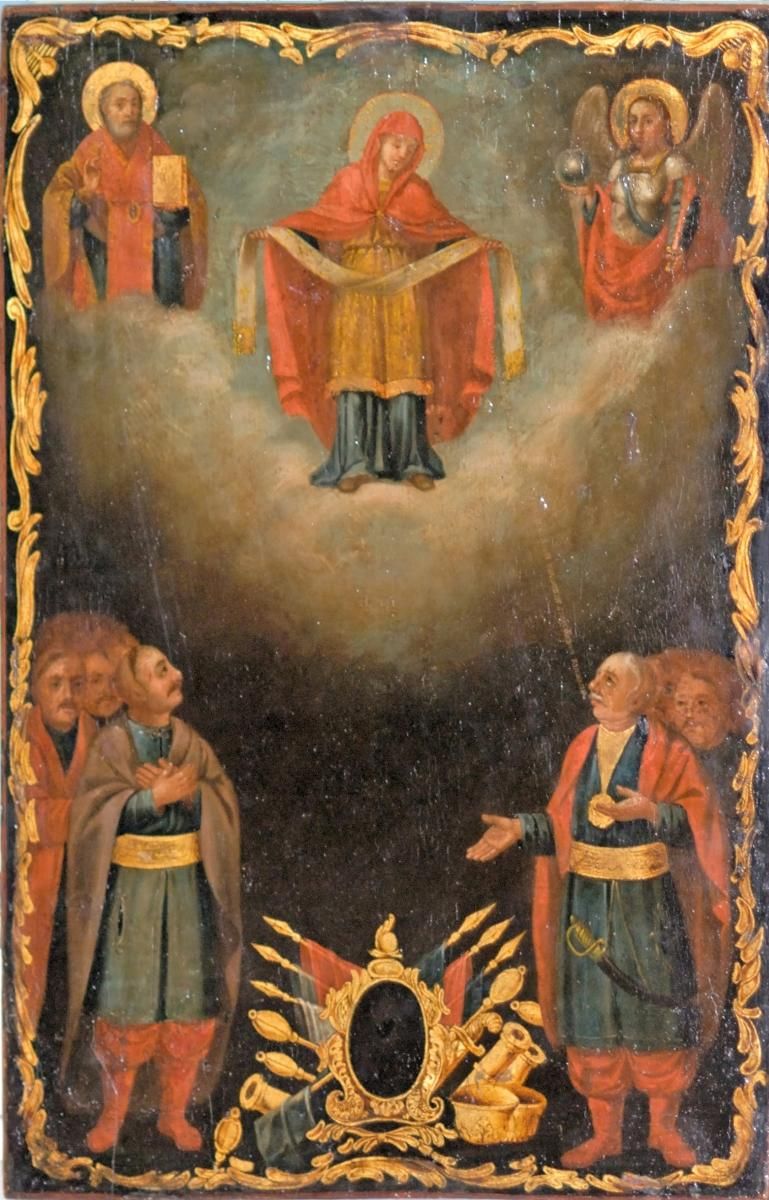
This type includes the magnificent Baroque images known as the “Cossack Pokrova,” in which we see hierarchs of the Ukrainian Church, Cossack leaders, and richly dressed townspeople under the Virgin’s Intercession. In one of them, Hetman Bohdan Khmelnytsky can even be recognized.
From Blachernae to Kyiv
One of the earliest authentic depictions of the Mother of God on the territory of Muscovy is located above the western gates of the Cathedral of the Nativity of the Theotokos in Suzdal. This cathedral was built at the beginning of the 13th century by Bishop Simon of Vladimir, a monk from the Kyiv-Pechersk Monastery and one of the authors of the Kyiv-Pechersk Patericon. Thus, the Suzdal Cathedral is almost a copy of the Dormition Cathedral of the Kyiv Lavra.
According to the legend from the Kyiv-Pechersk Patericon, the Dormition Cathedral was inspired by the Mother of God herself. She summoned four builders to the Blachernae Church (the very place where the miracle of the Intercession occurred), gave them an altar icon for the future cathedral, as well as gold to present to the founders of the Pechersk Monastery, Saints Anthony and Theodosius. This took place in the mid-11th century.
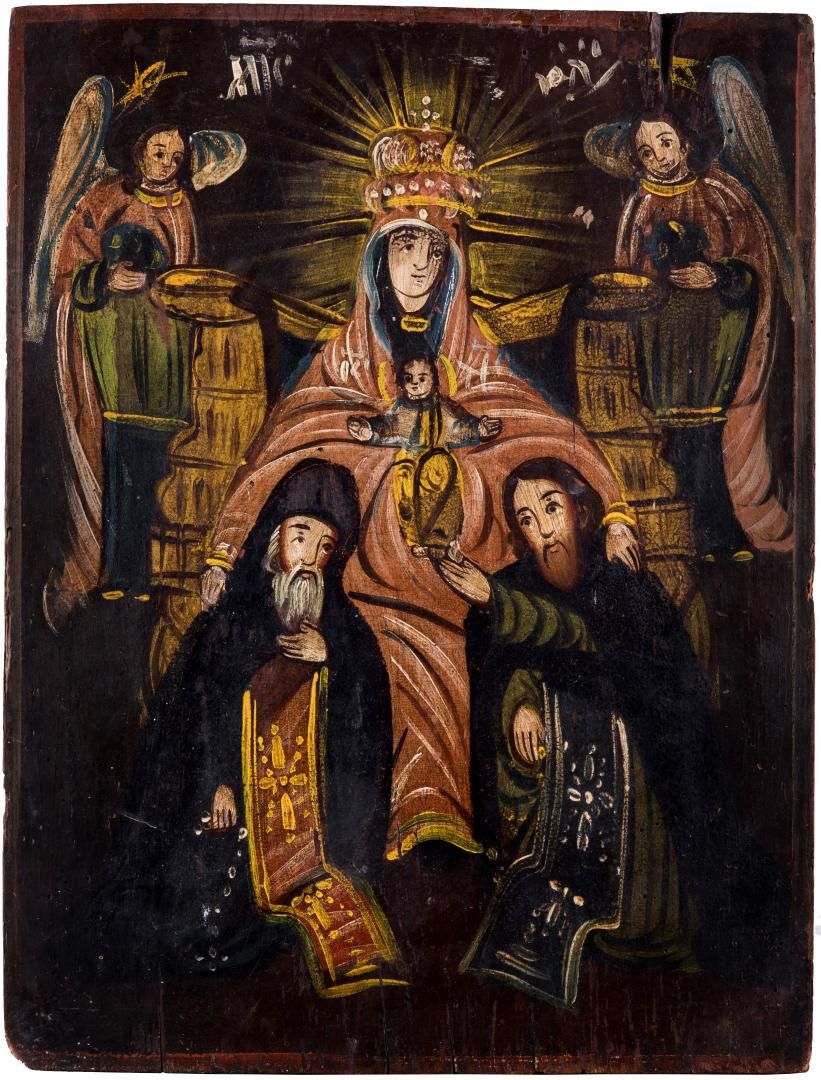
As medieval historian Volodymyr Aleksandrovych notes, the Kyivan cult of the Intercession (Pokrova) spread to Pskov and Novgorod, and later to Muscovy. However, the habit of associating the Feast of the Intercession with the Suzdal prince Andrei formed only around the mid-18th century, when the Russian Orthodox Church canonized Bogolyubsky.
Icons of the Intercession (Pokrova) in Russia are uniform in design. Their iconography took its final shape in the so-called “Vladimir-Suzdal” and “Novgorod” variants. One may suppose they are not authentic, since these principalities had no direct connection with Constantinople, the Mother Church. In such icons, the Mother of God is depicted above with the protection veil (“pokrova”), and below are the people, among whom is Saint Roman with a scroll. Incidentally, the scroll in his hands is also linked to the Mother of God. According to his Life, Roman at first could not sing, and others knew it — yet he very much wished to, since a deacon must sing beautifully. One night, the Mother of God appeared to him in a dream, gave him a scroll, and commanded him to eat it. The next day, everyone in the church was astonished by the beauty of his singing.
The Goddess of Bloody Victories
Perhaps the church on the Nerl River in the Vladimir-Suzdal principality, so symbolic for Muscovy, was also named the Church of the Intercession (Pokrova) sometime during that period. Before then, it was dedicated to a different Marian feast. According to legend, it was built by Andrei Bogolyubsky in 1165 in memory of his elder son Iziaslav, who died of wounds sustained after a victorious campaign of the proto-Muscovites against the Volga Bulgars.
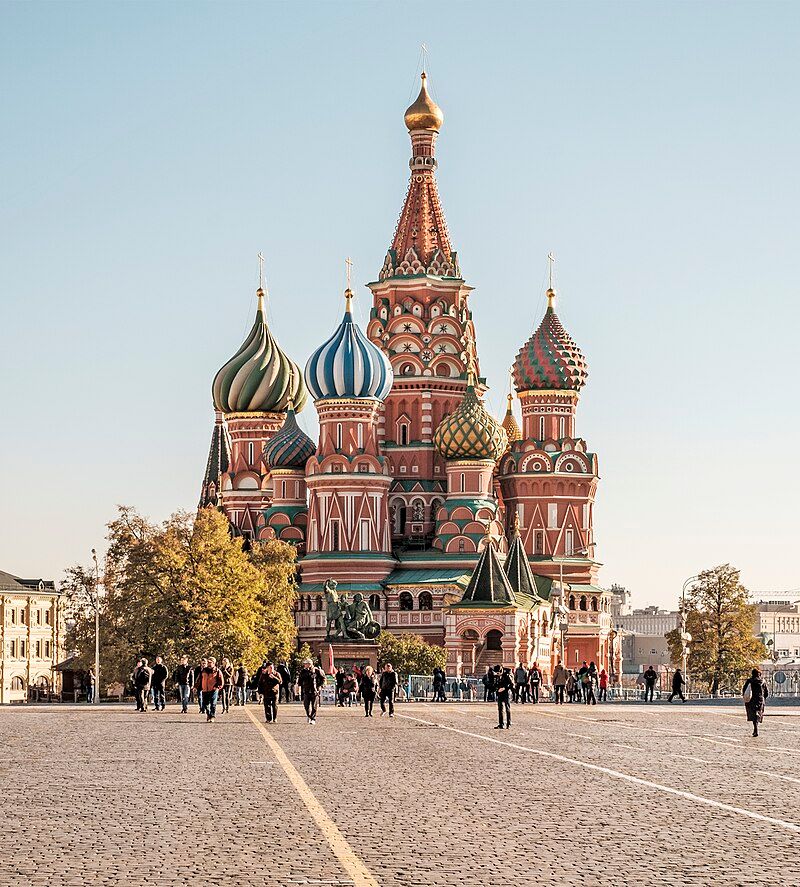
But the cathedral on Red Square in Moscow was built specifically as a Pokrovsky (Intercession) Church. This colorful temple is more widely known as “St. Basil’s Cathedral.” Ivan the Terrible ordered its construction after the conquest of Kazan in 1552. It was said that the storming of the Tatar capital began precisely on the Feast of the Intercession — October 1. Russians consider this cathedral a “warrior’s temple.” Its eight large domes symbolize “eight victories of Russian arms.”
In general, in Russian religious-state ideology, the image of the Intercession of the Mother of God (Pokrova) is used to instill the notions of Russia’s “divine chosenness,” “infallibility,” and “invincibility.”
Victorious dates in Russian military history are deliberately tied to the Feast of the Intercession (Pokrova):
• The conquest of Kazan (1552), which took place on the Feast of the Intercession.
• The Time of Troubles (1612), when Dmitry Pozharsky’s militia drove the Poles out of Moscow, carrying an icon of Our Lady of Kazan, later called the “Russian Pokrova.”
• The Battle of Poltava (1709): Peter I supposedly prayed before the Kazan icon, after which he defeated the Ukrainians and Swedes.
• Victory at Kinburn (1787): Count Suvorov, knowing that October 1 was Pokrova, patiently prayed at the liturgy until the Turks nearly reached the church itself — and finally triumphed.
• Ushakov’s Mediterranean campaign (1798): began on Pokrova with the capture of the island of Cythera, and Russian soldiers entered Rome “just in time for the Intercession.”
• The capture of Erivan (1827): The fortress city of Erivan (today Yerevan) was taken on October 1, 1827, after which the Armenian community allegedly thanked the “humane Muscovite nation.”
Dedication and the Intercession
According to Russian tales, Peter I, having prayed before the icon and defeated the Ukrainian-Swedish army at Poltava, sent three regiments of killers and looters to the Sich, who utterly destroyed the buildings and plundered the Church of the Intercession. After all, among Ukrainians, the feast of the Intercession was somehow “not the same” — it did not smell of the “Russian spirit.”
Taras Shevchenko wrote of this in his poem Irzhavets:
“The horde went through the kurins,
Seizing all the weapons,
While all the Muscovite officers
Stripped the church bare.
They took silver, they took gold,
Even waxen candles…”
In 1775, Empress Catherine II once again sent brigands against the Sich — nearly 70,000 of them. The first thing they plundered was the wealthy Sich Pokrova Church. Yet the Cossacks managed to save the Sich icon of the Intercession. Incidentally, this icon combined the two iconographic traditions of the Virgin mentioned earlier — Eastern and Western: the Mother of God is depicted in the upper register, while the Cossacks appear below.
In Ukraine, the concept of the Intercession (Pokrova), or the Merciful Mother, is of European origin and is based on consecration to God and to Mary — both personally and for the community or the entire country. The first acts of consecration of European cities and regions date back at least to the 9th century. The consecration of Kyiv and all Rus’ was carried out by Grand Prince of Kyiv Yaroslav the Wise, when he built the Church of the Annunciation over the Golden Gate.
A Pearl Kokoshnik and a Golden Backpiece
Among Ukrainians, the image of the Intercession (Pokrova) was often present on home icon shelves — alongside the Savior, the Virgin with Child, St. Nicholas, and St. George the Dragon-slayer. These were painted on both wood panels and glass. For Ukrainians, this image was close and deeply understandable.
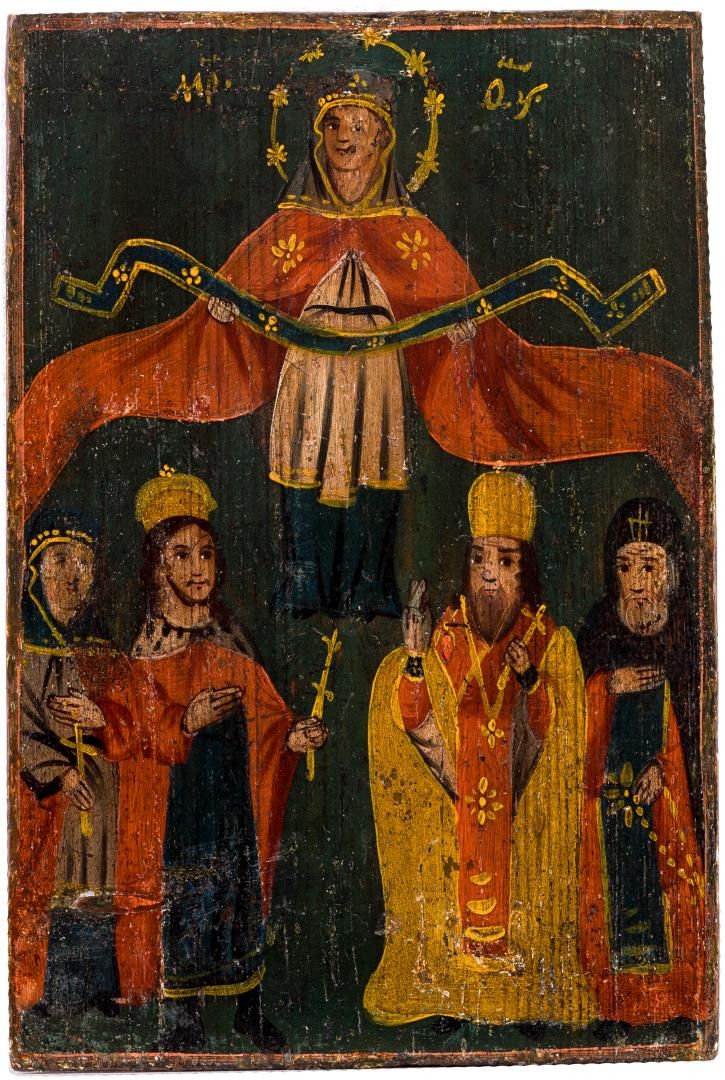
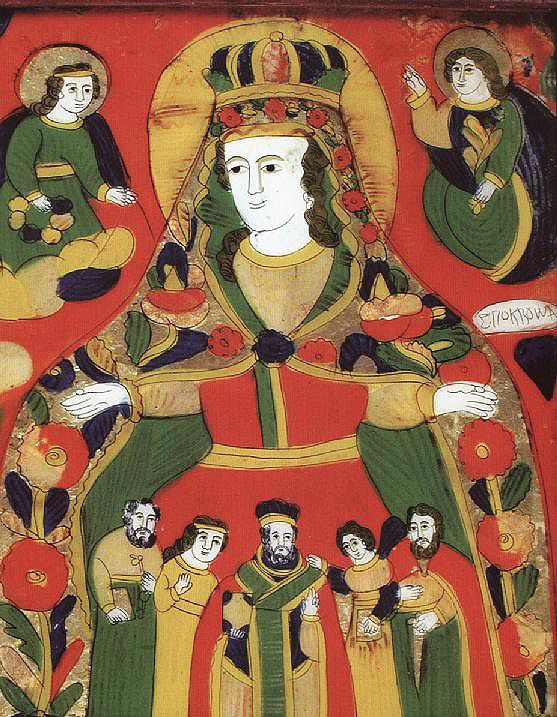
Were household folk icons of the Intercession (Pokrova) widespread in Muscovy? Art historian and iconography researcher Iryna Buseva-Davydova says that in Russia, the folk icon has only recently become a subject of study. However, a list of favorite themes in the “village” icon has already been compiled: “Nicholas the Wonderworker,” “polnitsy” (field spirits), Florus and Laurus, Blasius, George, Elijah the Prophet, Archangel Michael, and Paraskeva — but not the Intercession (Pokrova).
Still, there are folk traditions connected to the feast and certain popular notions about Pokrova. The feast was called by different names there: Pokrov Day, First Wintering, Wedding Day, Ambushes, Cutting Day, Day of Roman the Melodist, Pokrov-Batyushka (Father Pokrov). Girls would recite: “Pokrov-Batyushka, cover the earth with snow, and me with a bridegroom.” Or this: “Most Holy Intercession of the Mother of God! Cover my victorious head with a pearl kokoshnik and a golden headpiece!”
Until When Will “Russia Be Invincible”?
Some frankly pre-Christian “folk” notions can also be seen in the sermons of the chief “stakeholder” of Russian ideology today — Patriarch Kirill (Gundyaev). “The Queen of Heaven covered with her veil our Russian land, our church, and all Christians. This was clear from the vision at the root of the feast,” declared Kirill from the ambo on October 14, 2024. “The proof of the Virgin’s Intercession is her participation in the life of our country, in the history of our country,” emphasized the spiritual leader of the aggressor state without batting an eye. “And as long as this connection of our people with the Most Holy Mother of God is preserved, Russia will remain invincible.”
Every year, on October 14, Patriarch Kirill promotes the idea of Pokrova as a symbol of military victory and Russian statehood in his sermons. He says that “the Queen of Heaven has covered our Russian land and our church with her veil.” He calls the Mother of God a “warrior” and a “leader.” In 2022, he even asked the Queen of Heaven to extend over the Russians “her state veil” and grant them victory over those who “dream of destroying and subjugating Russia.”
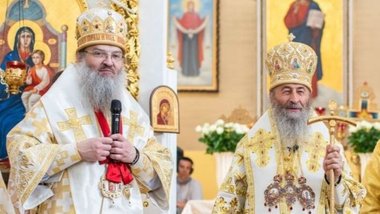
The priests of the “Ukrainian Orthodox Church,” as a branch of the ROC, are not free from such directives and quietly imbue their large congregations with this pan-Russian worldview. They do not publish their sermons openly, but quietly and steadily instill these ideas in their parishes over the course of decades. The only exception: Metropolitan Pavlo Lebid recorded a sermon on video in 2019. By that time, Ukraine had already been celebrating October 14 as Defenders’ Day for several years. In broken Russian, “Pasha-Mercedes” opposed the national idea to faith: “There are people who think this is the Intercession of some national ideas — nothing of the sort. This is the Intercession of faith and believers.” Of course! The ideology of the “state Pokrova-warrior” is defined as faith, while national defense against this pagan goddess is denounced as “heresy.”
The concept of the Feast of the Intercession (Pokrova) among Ukrainians and Russians truly differs radically. The Russian feast is, in essence, deadly for Ukrainians — and potentially for all humanity. For it is imbued with the idea of conquest, military triumphs, and impunity for every crime, since “the Mother of God is with them.”
This publication was released within the framework of the RISU project “Historical Memory VS the Russian World.”
##DONATE_TEXT_BLOCK##